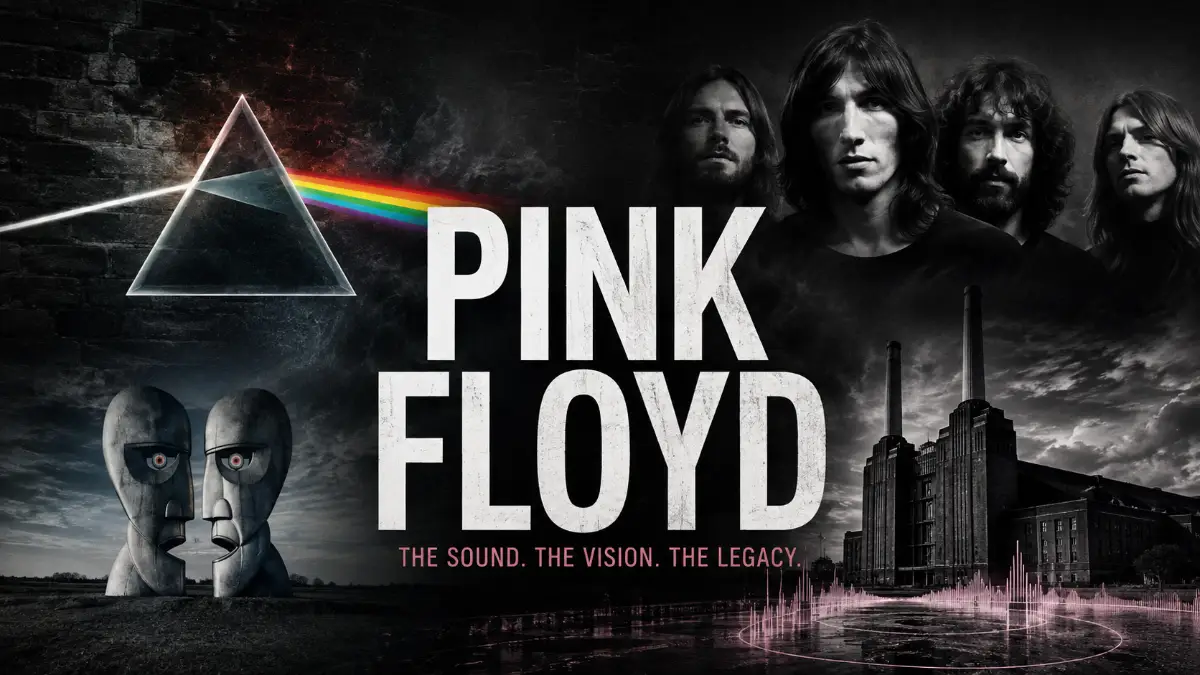
Pink Floyd did not become essential listening simply by writing famous songs. The English band built self-contained musical worlds: records where lyrics, instrumental passages, studio effects, cover art, and stage design all reinforce a shared idea. From Syd Barrett’s psychedelic imagination to the monumental albums shaped by Roger Waters, David Gilmour, Richard Wright, and Nick Mason, Pink Floyd changed what a rock album could ask listeners to experience.
This guide approaches the band through its creative turning points and listening choices. Whether you know “Wish You Were Here” from radio, want to understand The Dark Side of the Moon, or are deciding between Animals and The Wall, it explains where each record fits and why the music still matters.
Pink Floyd at a glance
| Topic | Essential answer |
| Origin | London, England |
| Formation | 1965 |
| Original lineup | Syd Barrett, Roger Waters, Nick Mason, Richard Wright |
| Fifth principal member | David Gilmour, who joined in 1967 |
| Musical foundations | Psychedelic rock, progressive rock, art rock, experimental rock |
| Studio catalog | 15 studio albums |
| Best-known album | The Dark Side of the Moon |
| Biggest hit single | “Another Brick in the Wall, Part 2” |
| Final studio album | The Endless River (2014) |
| Major honor | Inducted into the Rock and Roll Hall of Fame in 1996 |
| Grammy-winning track | “Marooned,” Best Rock Instrumental Performance, 1995 |
The band’s original members were Barrett, Waters, Mason, and Wright. David Gilmour joined near the end of 1967 and became the group’s most recognizable guitarist and one of its principal vocalists. Its musical story is therefore not one stable lineup but several connected eras.
Why Pink Floyd sounds different
Pink Floyd’s music often feels spacious because it treats timing, silence, and sound texture as compositional tools. A guitar note may be held longer than expected; a drum pattern may leave room around the beat; a keyboard chord may carry a song more than a riff.
The group’s best albums also build meaning through details that are easy to miss on a first listen:
- Spoken voices make abstract themes sound human and immediate.
- Tape loops and found sounds turn clocks, cash registers, machinery, and radio fragments into narrative devices.
- Long introductions create anticipation rather than merely delaying the song.
- Repeated musical phrases help separate tracks feel connected.
- Instrumental passages often express what the lyrics leave unresolved.
That approach is why the band can feel cinematic without writing film scores. The arrangements suggest environments: a classroom, a factory, an arena, a memory, a psychological crisis, or an empty landscape.
- Read more: Pink Floyd
The five musicians behind the catalog
The group’s identity came from collaboration as much as from individual personalities. Each principal member brought a different musical function, and the balance among them changed over time.
| Musician | Musical role | Best way to hear the contribution |
| Syd Barrett | Early songwriter, guitarist, singer | The Piper at the Gates of Dawn, “See Emily Play,” “Astronomy Domine” |
| Roger Waters | Bassist, lyricist, conceptual architect | Animals, The Wall, The Final Cut |
| David Gilmour | Guitarist, singer, songwriter | “Time,” “Comfortably Numb,” “Shine On You Crazy Diamond” |
| Richard Wright | Keyboardist, singer, composer | “Us and Them,” “The Great Gig in the Sky,” “Summer ’68” |
| Nick Mason | Drummer, percussionist, sonic detail | “One of These Days,” “Money,” “Run Like Hell” |
Syd Barrett and the first version of the band
Syd Barrett gave the early group its distinctive voice. His songs could be playful, surreal, unsettling, and melodic at once, often using everyday images—bicycles, scarecrows, cats, rooms, clothes—to create an off-kilter imaginative world.
On The Piper at the Gates of Dawn, Barrett’s songwriting is not a prototype for later albums so much as a separate creative universe. The record matters because it shows the band’s earliest willingness to use rock music for fantasy, sound exploration, and unusual forms.
Roger Waters and the rise of the concept album
Roger Waters became increasingly important after Barrett’s departure. His lyrics and concepts gave the group a more focused subject matter: time, mortality, money, social hierarchy, war, celebrity, institutional power, and emotional isolation.
Waters’s role is most pronounced on Animals, The Wall, and The Final Cut. Yet the classic records work because his conceptual focus was interpreted through Gilmour’s melody and guitar, Wright’s harmony and keyboards, and Mason’s measured rhythm.
David Gilmour and melodic release
David Gilmour’s playing is often described as expressive because it favors phrasing over density. His solos do not rush to fill every available space; they build tension, pause, and resolve at carefully chosen moments.
His lead vocals also matter. Where Waters often writes from a viewpoint shaped by frustration, fear, or accusation, Gilmour’s voice can bring openness and warmth. “Comfortably Numb” is a useful example: the song’s dramatic power depends on the contrast between Waters’s narrative and Gilmour’s melodic performance.
Richard Wright and the band’s inner space
Richard Wright was crucial to the group’s sense of depth. His keyboards often create the musical setting before the lyrics arrive, whether through electric piano, organ, synthesizer, or layered vocal harmony.
“Us and Them” demonstrates this especially well. Its slow movement and spacious chords let the song’s anti-conflict lyric feel reflective rather than declarative. Wright’s work is also central to the dreamlike pull of “The Great Gig in the Sky” and the later-era atmosphere of The Division Bell.
Nick Mason and controlled momentum
Nick Mason’s drumming is rarely about spectacle. His contribution is more structural: he supports shifts in intensity and gives the music enough motion to keep long arrangements from drifting.
The opening of “One of These Days,” the rhythmic tension of “Money,” and the drive of “Run Like Hell” show how percussion helps define the group’s scale. Mason is also the only musician to have appeared on every Pink Floyd studio album.
A journey through the albums
The most useful way to understand the discography is to hear it as a sequence of creative problems the band kept solving: how to continue after Barrett, how to turn improvisation into structure, how to make concept albums emotionally convincing, and how to continue after internal divisions.
1. The psychedelic beginning: 1967–1968
The Piper at the Gates of Dawn introduced a band rooted in London’s underground scene, where light shows, extended improvisation, feedback, and emerging recording technology were part of the experience. The 1967 debut remains one of British psychedelia’s defining albums.
A Saucerful of Secrets documents a period of transition. Barrett’s presence overlaps with Gilmour’s arrival, and the music points toward a more collective, exploratory direction.
2. The experimental years: 1969–1972
The next several releases were uneven by conventional standards but vital to the band’s development. More and Obscured by Clouds were film soundtracks; Ummagumma paired live recordings with individual studio experiments; Atom Heart Mother tested orchestral scale.
The breakthrough was Meddle in 1971. “Echoes,” its 23-minute closing track, is the key work from this phase. It uses gradual development, shifting textures, call-and-response vocals, and long instrumental passages to produce a coherent journey rather than a loose jam.
3. The four-album summit: 1973–1979
Between 1973 and 1979, the group made four albums that became the center of its legacy.
| Album | Central concern | Listening payoff |
| The Dark Side of the Moon | Pressure, time, money, conflict, mental strain | Immediate songs joined into a seamless whole |
| Wish You Were Here | Absence, Syd Barrett, artistic alienation | Emotional directness and refined studio sound |
| Animals | Social hierarchy, power, cynicism | Darker tone and long guitar-driven pieces |
| The Wall | Trauma, fame, isolation, emotional defense | A narrative double album with major singles |
These records show different versions of the same strength: the band could connect large themes to memorable musical moments. A ticking clock, an acoustic guitar entrance, a shouted vocal, a keyboard chord, or a soaring solo can carry as much emotional weight as a lyric.
4. Division and continuation: 1983–2014
The Final Cut is closely identified with Waters’s writing and reflects the growing strain inside the group. He left in 1985, after which Gilmour and Mason continued the band and Wright returned first as a contributor, then as a full member.
The later albums, A Momentary Lapse of Reason and The Division Bell, do not reproduce the exact creative balance of the 1970s quartet. They offer a more polished, guitar-forward, atmospheric sound. The Endless River, released in 2014, is largely instrumental and draws on material from The Division Bell sessions; it functions in part as a tribute to Wright, who died in 2008.
Which Pink Floyd album fits your taste?
A first album should match what you already enjoy, not what a canon tells you to admire.
| If you like… | Start here | Then continue with |
| Albums that work as complete statements | The Dark Side of the Moon | Wish You Were Here |
| Acoustic rock and emotionally direct songs | Wish You Were Here | The Division Bell |
| Political lyrics and extended guitar sections | Animals | The Final Cut |
| Rock operas and character-driven stories | The Wall | The Wall live recordings |
| 1960s psychedelia | The Piper at the Gates of Dawn | A Saucerful of Secrets |
| Instrumental development and sonic atmosphere | Meddle | Atom Heart Mother |
| Concert-scale performances | Pulse | Delicate Sound of Thunder |
For a single best starting point, choose The Dark Side of the Moon. It is the clearest meeting point of Waters’s themes, Gilmour’s guitar and vocals, Wright’s keyboard writing, Mason’s drumming, and the group’s studio imagination.
The records that define the band
The Dark Side of the Moon: an album about ordinary pressure
Released in 1973, The Dark Side of the Moon brings together concerns that affect nearly everyone: the speed of time, the demands of work, financial anxiety, conflict, mortality, and the fear of psychological collapse.
Its success comes partly from the way it avoids abstract lectures. “Time” turns a universal worry into a direct warning about missed opportunities. “Money” uses a distinctive bass pattern and sound effects to make its satire physical and memorable. “Us and Them” approaches conflict through a slow, mournful arrangement rather than a slogan.
The album was recorded at Abbey Road Studios, and engineer Alan Parsons contributed to its innovative sound design. Its continuous flow, including voice recordings, clock effects, and recurring transitions, makes it especially rewarding to hear from beginning to end.
Wish You Were Here: absence as a musical subject
Released in 1975, Wish You Were Here centers on what happens when connection breaks down. Syd Barrett’s absence is a major emotional presence in “Shine On You Crazy Diamond,” while “Welcome to the Machine” and “Have a Cigar” confront the pressures surrounding commercial music.
The title song is unusually plainspoken. Its emotional power comes from restraint: a recognizable acoustic-guitar figure, a conversational vocal, and a lyric that leaves room for listeners to apply their own experiences of distance or loss.
Animals: Pink Floyd at its most confrontational
Released in 1977, Animals is a harder-edged album built around three extended pieces: “Dogs,” “Pigs (Three Different Ones),” and “Sheep.” Its animal imagery recalls George Orwell’s Animal Farm, but the record uses those categories to examine contemporary power, status, aggression, and conformity.
The album is less immediately welcoming than The Dark Side of the Moon, but its tension is purposeful. Gilmour’s guitar work is more exposed, Waters’s writing more caustic, and the arrangements less concerned with conventional hit-making.
The Wall: when protection becomes isolation
Released in 1979, The Wall tells the story of Pink, a fictionalized rock star whose losses, fears, and public pressures lead him to construct a psychological barrier between himself and other people.
“Another Brick in the Wall, Part 2” became the group’s biggest hit, but the album’s emotional center may be “Comfortably Numb,” where a detached narrative meets one of Gilmour’s most celebrated guitar performances. The record’s story later expanded into major stage productions and a 1982 film.
Beyond the studio albums: live and archival listening
The studio catalog is the essential foundation, but live releases reveal how the group changed its material onstage.
| Release | What it offers |
| Ummagumma | A document of the early live band, including “Careful with That Axe, Eugene” |
| Delicate Sound of Thunder | The scale of the late-1980s touring production |
| Pulse | A complete live performance of The Dark Side of the Moon and a strong overview of the later touring era |
| Is There Anybody Out There? The Wall Live 1980–81 | The original The Wall concert production |
| The Dark Side of the Moon: Live at Wembley 1974 | A vital document of the classic lineup performing its breakthrough album |
| The Early Years 1965–1972 | Archival material that charts the path from psychedelia to progressive rock |
For a compact overview rather than a deep dive, Echoes: The Best of Pink Floyd is useful because it spans the full career. Listeners who want the full studio journey can look for the Discovery box, which gathers the core albums.
How the band made its records feel so immersive
The group’s recording methods are a major part of its identity. Rather than treating production as a final polish, the musicians used the studio to shape the meaning of the songs.
| Technique | Example | Effect |
| Found sound | Clocks in “Time”; cash registers in “Money” | Turns themes into audible experiences |
| Tape loops and editing | Collaged effects and repeating patterns | Adds motion, unease, or continuity |
| Synthesizer texture | The Dark Side of the Moon and Wish You Were Here | Creates atmosphere without always relying on riffs |
| Layered vocals | “Brain Damage,” “Hey You,” “Shine On You Crazy Diamond” | Enlarges emotional climaxes |
| Long-form dynamics | “Echoes,” “Dogs,” “Shine On You Crazy Diamond” | Makes gradual changes feel dramatic |
| Seamless sequencing | The Dark Side of the Moon | Helps an album work as one experience |
The visual side followed the same logic. Hipgnosis, particularly Storm Thorgerson and Aubrey Powell, developed sleeve designs that gave each record a recognizable conceptual image: the prism, the burning businessmen, the Battersea pig, and the wall.
Why the band’s influence reaches beyond progressive rock
Pink Floyd helped make ambitious rock albums viable on a global scale. Its influence is not limited to bands that sound similar; it appears wherever artists use the album as a unified artistic statement rather than a container for unrelated tracks.
Musical descendants and affinities
- Progressive-rock bands adopted the group’s willingness to use long-form structure and thematic continuity.
- Psychedelic artists continue to draw on Barrett’s surreal lyricism and exploratory guitar textures.
- Art-rock and alternative artists have used atmosphere, studio experimentation, and narrative ambiguity in ways that invite comparison.
- Post-rock musicians have similarly relied on slow builds, dynamic contrast, and texture-led arrangements.
- Progressive-metal bands such as Tool and Dream Theater operate in a market where conceptual records and immersive live presentation have an established audience.
- Porcupine Tree and Steven Wilson have carried forward an interest in detailed production, album continuity, and long-form listening.
- Radiohead is frequently discussed in the broader art-rock tradition of groups willing to make challenging, technologically adventurous albums for a large audience.
A legacy of images and performances
The band’s influence is visual as well as musical. Its concerts demonstrated that lighting, film, large-scale props, and projection could make a live show part of the work’s meaning. The flying pig, circular screen, and The Wall stage architecture became as recognizable as many of the songs.
That legacy can be seen in modern arena and festival productions where video, lighting, narrative imagery, and stage design are treated as central to the performance rather than decoration.
Recognition, commercial reach, and current status
The group entered the Rock and Roll Hall of Fame in 1996. “Marooned,” from The Division Bell, won the Grammy Award for Best Rock Instrumental Performance in 1995. The Dark Side of the Moon and The Wall remain two of the most commercially successful and culturally prominent rock albums ever released.
The Dark Side of the Moon is widely reported to have sold more than 45 million copies worldwide, although exact totals vary according to certification systems and sales-reporting methods. Its commercial success matters not merely as a number: it demonstrated that an album built around connected themes and experimental sound could become a mainstream cultural fixture.
Pink Floyd is not an active, regularly touring band. Gilmour, Waters, and Mason have undertaken separate work; Barrett died in 2006 and Wright in 2008. The 2022 track “Hey, Hey, Rise Up!” was a one-off release by Gilmour and Mason rather than a full reunion. The classic quartet of Gilmour, Waters, Mason, and Wright last performed together at Live 8 in London in 2005.
A practical first-week listening plan
If you want to move beyond the obvious songs without getting lost in a large catalog, use this seven-session route.
- Begin with The Dark Side of the Moon. Listen without shuffle and notice how one song flows into the next.
- Play “Wish You Were Here” and “Shine On You Crazy Diamond.” This introduces the group’s acoustic intimacy and long-form patience.
- Try “Echoes.” Its length is the point: follow how the arrangement changes rather than searching for a conventional chorus.
- Choose Animals if you want tension. Start with “Dogs,” then return later to hear the full album in sequence.
- Choose The Wall if you want narrative. Begin with “Another Brick in the Wall, Part 2,” “Mother,” “Hey You,” and “Comfortably Numb,” then hear the complete double album.
- Go backward to Barrett. Play The Piper at the Gates of Dawn after the 1970s classics to hear how radically different the early voice was.
- Finish with a live release. Pulse offers a useful reminder that the songs were built to expand onstage.
The best way to understand the band is not to chase a single “greatest” album. Hear how each era answers a different question: how far can a song stretch, how much can a studio create, and how directly can a rock record confront fear, memory, power, and loss?
Frequently asked questions
Why is Pink Floyd considered so influential?
Pink Floyd showed that rock music could combine experimental sound, strong songwriting, visual art, and album-length themes without becoming inaccessible to a large audience. Its records helped popularize the concept album, while its concerts raised expectations for lighting, projection, film, and stage design. The band also influenced musicians through Gilmour’s melodic guitar approach, Barrett’s psychedelic creativity, Waters’s thematic writing, Wright’s atmospheric keyboards, and its use of the recording studio as a compositional tool.
What is the easiest Pink Floyd album for beginners?
The Dark Side of the Moon is usually the easiest and most rewarding first album. It is concise, highly melodic, and built around themes that are immediately understandable, including time, work, money, conflict, and mortality. It also captures the strengths of the classic lineup in one place. If you prefer acoustic songwriting, begin with Wish You Were Here; if you prefer narrative drama and famous rock songs, choose The Wall.
What is the difference between the Syd Barrett and David Gilmour eras?
The Syd Barrett era is defined by whimsical lyrics, British psychedelic pop, unpredictable song forms, and experimental guitar sounds. Gilmour joined in 1967 and helped lead the group toward a more melodic, spacious, and guitar-centered style. The later classic lineup combined Gilmour’s musical clarity with Waters’s concepts, Wright’s keyboard textures, and Mason’s rhythmic restraint. Barrett’s influence remained important, especially on Wish You Were Here, but the two eras have very different musical personalities.
Why did Pink Floyd use so many sound effects?
The sound effects are part of the writing, not just decoration. Clocks make the theme of passing time physical in “Time”; cash-register sounds introduce the subject of money before the lyric begins; machinery in “Welcome to the Machine” supports the song’s critique of impersonal systems. Spoken voices, tape loops, and environmental recordings also help connect separate tracks, making albums such as The Dark Side of the Moon feel like complete, continuous experiences.
Is The Wall based on a true story?
The Wall is fictional, but it draws on personal experiences and concerns associated with Roger Waters, including loss, alienation, fame, and the psychological impact of war. The central character, Pink, is not a straightforward portrait of one real person. Instead, the album uses him to explore how trauma, institutions, celebrity, and emotional withdrawal can isolate someone from other people. Its story later became the basis for a stage production and the 1982 film.
What did Pink Floyd perform at Live 8?
The classic surviving quartet—David Gilmour, Roger Waters, Nick Mason, and Richard Wright—reunited at Live 8 in London on July 2, 2005. Their set included “Speak to Me/Breathe,” “Breathe,” “Money,” “Wish You Were Here,” and “Comfortably Numb.” The performance was historically important because Waters had not appeared with the group since leaving in 1985. It remained a one-off reunion rather than the start of a new album or tour.
Which Pink Floyd album has the best guitar playing?
The answer depends on the kind of guitar performance you want. Animals is often the strongest choice for extended, aggressive, and improvisatory David Gilmour work, especially on “Dogs.” The Wall contains the celebrated “Comfortably Numb” solos, while Wish You Were Here includes the long, melodic development of “Shine On You Crazy Diamond.” The Division Bell is a good late-period choice for listeners who want Gilmour’s tone and phrasing in polished, spacious arrangements.
What is the meaning of “Shine On You Crazy Diamond”?
“Shine On You Crazy Diamond” is widely understood as a tribute to Syd Barrett, the group’s original frontman and early songwriter. Its lyrics and extended arrangement express admiration, distance, sadness, and memory rather than offering a literal account of Barrett’s life. The piece opens and closes Wish You Were Here, giving the album a circular structure. Its slow introduction, keyboard textures, and Gilmour guitar phrases make it one of the band’s clearest examples of emotional storytelling without direct explanation.
Did the band ever reunite after Roger Waters left?
Yes, but only briefly. Waters rejoined Gilmour, Mason, and Wright for the 2005 Live 8 performance in London. The appearance was the first time that classic surviving quartet had played together since Waters’s 1985 departure. It did not lead to a full reunion, tour, or new studio album. Gilmour and Waters have since followed separate artistic paths, while Mason has performed Pink Floyd material with his own touring project.
Are Pink Floyd still making new music?
The band is not functioning as a regular recording or touring unit. Its final studio album was The Endless River in 2014. In 2022, Gilmour and Mason released “Hey, Hey, Rise Up!” under the group’s name in support of Ukraine; it was a standalone project rather than a restart of the band. Any future release or performance would depend on an official announcement from the artists involved.