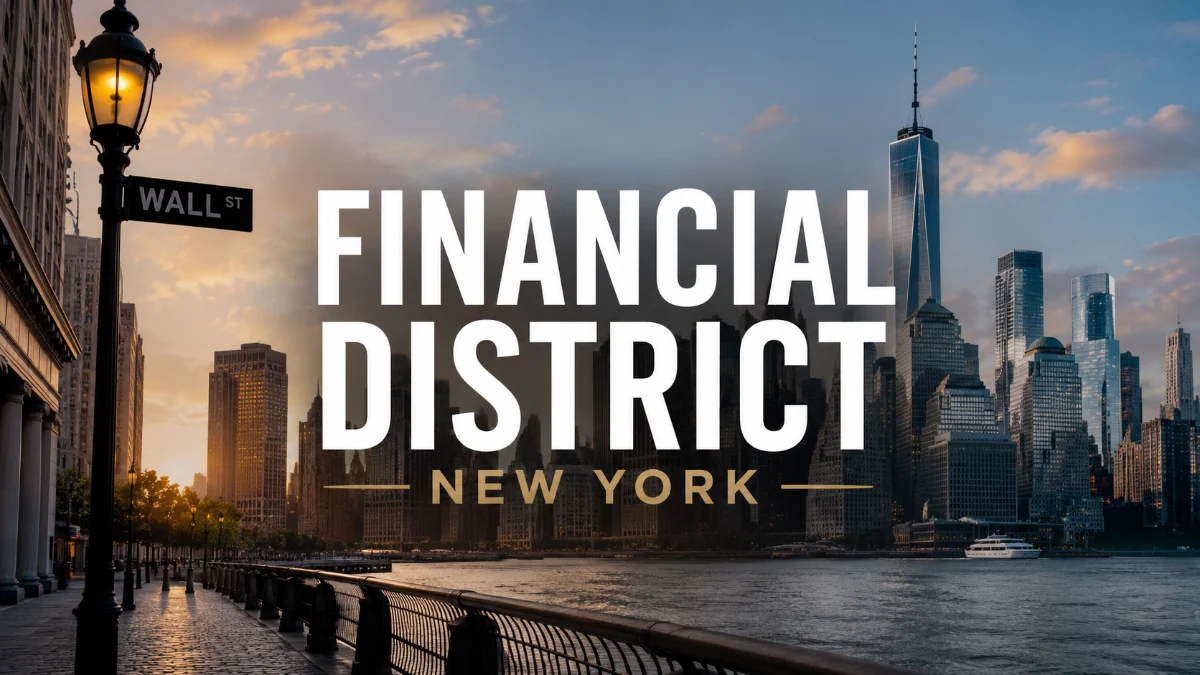
The Financial District New York is far more than Wall Street. At the southern tip of Manhattan, this compact neighborhood combines the 9/11 Memorial, One World Trade Center, historic civic landmarks, harbor views, ferry terminals, museums, and some of New York City’s oldest streets.
For first-time visitors, FiDi offers one of the clearest introductions to the city’s past and present. You can see major Lower Manhattan attractions in a few hours, but a full day gives you time for meaningful museum visits, waterfront walks, historic sites, and a relaxed meal.
Why Visit the Financial District?
The Financial District, commonly called FiDi, is Lower Manhattan’s historic and commercial center. It is home to Wall Street, the World Trade Center campus, Federal Hall, Trinity Church, Battery Park, Whitehall Terminal, and the South Street Seaport area.
The neighborhood feels very different from Midtown. Instead of broad avenues, theater crowds, and neon signs, visitors find narrow streets, stone facades, office towers, public memorials, waterfront promenades, and major national landmarks.
It is also one of the city’s most efficient sightseeing areas. Many headline attractions are within walking distance, and subway lines and ferry connections make it easy to continue to Brooklyn, Staten Island, Liberty Island, Ellis Island, or other parts of Manhattan.
- Read more: Financial District New York
What Is the Financial District in Manhattan?
The Financial District occupies the southern end of Manhattan and is centered around Wall Street, the New York Stock Exchange, and the World Trade Center. Its exact boundaries can vary, but visitors generally use the term for the area between the Brooklyn Bridge and Battery Park, extending from the East River to the Hudson River side.
FiDi is both a working business district and a major visitor destination. It developed before Manhattan’s later street grid, which explains its short blocks, irregular intersections, and historic street names. A walk through the neighborhood can move quickly from colonial-era history to 19th-century civic architecture, early skyscrapers, and contemporary towers.
Financial District New York vs. Lower Manhattan
Lower Manhattan refers to the wider southern section of the island. The Financial District is one of its best-known neighborhoods.
For travelers, the distinction is often less important than the itinerary. One World Trade Center, the 9/11 Memorial, Wall Street, Federal Hall, Trinity Church, Battery Park, and the Staten Island Ferry are all close enough to combine in a single visit. Nearby areas such as the Seaport, Civic Center, Tribeca, Chinatown, and the Brooklyn Bridge approach can be added if you have more time.
Top Things to Do in Financial District NYC
The best things to do in Financial District NYC combine landmark sightseeing with historic context and time by the water. Prioritize two or three major attractions, then use the streets between them as part of the experience rather than treating the neighborhood as a checklist.
| Attraction | Why Visit | Best For | Allow |
| 9/11 Memorial | Reflecting pools at the former Twin Towers site | Reflection, history, architecture | 30–60 minutes |
| 9/11 Memorial Museum | Detailed interpretation of September 11 and its aftermath | Visitors seeking deeper historical context | 1–2 hours |
| One World Observatory | Sweeping views from One World Trade Center | Skyline views and first-time visits | 45–60 minutes |
| Wall Street and Broad Street | New York Stock Exchange exterior and financial history | Iconic landmarks and architecture | 20–40 minutes |
| Federal Hall National Memorial | Landmark of early U.S. government | American history | 30–60 minutes |
| Trinity Church | Gothic Revival church and historic churchyard | Architecture and Hamilton history | 20–40 minutes |
| Battery Park | Harbor promenade and ferry departure point | Statue views and outdoor time | 30–90 minutes |
| Staten Island Ferry | Free harbor crossing from Whitehall Terminal | Budget travelers and photographers | About 1 hour round trip, plus waiting |
| South Street Seaport | Historic waterfront streets, dining, and river views | Food, shopping, and sunset walks | 45–90 minutes |
1. Visit the 9/11 Memorial
The 9/11 Memorial is one of the most significant places to visit in Lower Manhattan. It occupies the footprints of the former Twin Towers and features two large reflecting pools bordered by bronze panels inscribed with the names of those killed in the September 11, 2001 attacks and the 1993 World Trade Center bombing.
The outdoor Memorial is free and open daily. It is best approached as a place for quiet reflection rather than a quick photo stop. Walk around both pools, take time to read the names, and notice how the water and surrounding plaza shape the atmosphere of the site.
The adjacent 9/11 Memorial Museum requires a timed ticket and provides a much deeper historical visit. Through artifacts, photographs, recorded testimony, and exhibits, it examines the attacks, their victims, rescue and recovery efforts, and the broader aftermath. Most visitors should allow at least 60 to 90 minutes if they plan to experience it without rushing.
2. See One World Trade Center and One World Observatory
One World Trade Center defines the modern Lower Manhattan skyline. Its surrounding campus, public spaces, transportation hub, memorial, and nearby streets show how the area has been rebuilt and reshaped since 2001.
For panoramic views, reserve a timed ticket for One World Observatory. Located on floors 100 through 102, the observatory looks across Manhattan, Brooklyn, New Jersey, New York Harbor, and the Atlantic-facing waterfront on clear days.
A visit generally takes 45 minutes to one hour, though waits, weather, and crowds can affect timing. If you have a museum ticket or a ferry reservation on the same day, leave extra time between entries rather than scheduling them back to back.
Operating hours, ticket types, and entry procedures can change. Booking in advance is particularly useful during weekends, school holidays, and peak tourist seasons.
3. Walk Wall Street and Broad Street
Wall Street is short and often quieter than first-time visitors expect, but its historical and symbolic importance is enormous. The street represents centuries of banking, commerce, securities trading, and New York’s role in the global financial system.
Begin near Broad Street, where the New York Stock Exchange building stands. The exchange is an active institution, not a standard walk-in tourist attraction, so visitors should plan to view its exterior and explore the surrounding streets rather than expect access to the trading floor.
From there, walk toward Federal Hall and Trinity Church. Look beyond the familiar street signs: the neighborhood’s architectural mix tells its own story, from monumental early-20th-century financial buildings to postwar towers and newer World Trade Center development.
4. Explore Federal Hall National Memorial
Federal Hall National Memorial, at 26 Wall Street, stands near the site where George Washington took the oath of office as the first president of the United States in 1789. The site also served as the first seat of the new federal government, including the First Congress and the early Supreme Court.
The present building was completed later and originally served as the U.S. Custom House. Today, its exhibits explore George Washington, the Constitution, the early federal government, and New York’s role in the nation’s founding.
Admission is free when the building is open. Interior hours and access may change, so check current conditions before going. Even if the building is closed, the exterior, broad front steps, and statue of Washington make this an important stop on a Financial District walking tour.
5. Visit Trinity Church and Its Churchyard
Trinity Church stands at Broadway and Wall Street, framed by office towers and busy downtown streets. The current Gothic Revival building is one of Lower Manhattan’s most recognizable landmarks and provides a striking contrast with the financial district around it.
The churchyard is a key stop for visitors interested in early American history. Alexander Hamilton, the first U.S. secretary of the treasury, is buried there, along with other figures connected to colonial and early New York.
This is an easy stop between Wall Street and Battery Park. It remains an active place of worship, so visitors should be respectful and check access conditions around services, events, and special programs.
6. Take a Break at Battery Park
Battery Park is a waterfront green space at Manhattan’s southern edge, with views toward the Statue of Liberty, Ellis Island, New York Harbor, and the Jersey City skyline. It is a natural place to pause after exploring Wall Street or the World Trade Center area.
The park is also the New York departure point for ferries to Liberty Island and Ellis Island. Travelers planning to visit both islands should reserve tickets in advance and allow substantial time for security screening, boarding, the crossing, and museum visits. Ferry schedules vary by season, and later entries may not leave enough time to visit both islands comfortably.
Use the authorized ferry service from Battery Park rather than buying from unofficial street sellers. The official ticket office is inside Castle Clinton National Monument. Security screening is required before boarding.statuecitycruises+2
Even if you are not taking a ferry, Battery Park is worth visiting for its waterfront paths and harbor views. Mornings are often calmer, while late afternoon can be especially pleasant for light, cooler temperatures, and photographs.
7. Ride the Staten Island Ferry for Free Harbor Views
The Staten Island Ferry is one of the best no-cost experiences near the Financial District. It runs between Whitehall Terminal in Lower Manhattan and St. George Terminal on Staten Island. The ferry is free, operates year-round, and the crossing takes about 25 minutes each way.
The route gives passengers wide views of Lower Manhattan, New York Harbor, the Statue of Liberty, and the Verrazzano-Narrows Bridge. It is public transportation rather than a dedicated sightseeing cruise, so expect commuters and regular transit activity, especially on weekdays.
For a simple sightseeing outing, board at Whitehall Terminal, enjoy the crossing, disembark at St. George, and return on a later ferry. Check the current timetable before you go, particularly on weekends, holidays, or days with poor weather.
8. Wander the South Street Seaport
The South Street Seaport area offers a more relaxed side of Lower Manhattan. Near the East River, it combines historic streets, low-rise buildings, waterfront paths, restaurants, and Pier 17.
It is a strong choice for visitors who want to end a day of museums and landmarks with food or views rather than another indoor attraction. The waterfront also offers appealing perspectives toward the Brooklyn Bridge and the Brooklyn skyline.
Walk the surrounding streets, explore the piers, and consider arriving near sunset. The Seaport pairs well with a Brooklyn Bridge walk, especially if you continue toward DUMBO or Brooklyn Bridge Park afterward.
A Practical Financial District New York Walking Tour
A self-guided Financial District walking tour is the most efficient way to understand the neighborhood. Major sights are close together, but visitors should account for museum entry times, security screening, crowds, weather, and breaks.
Best 3-Hour Itinerary
This route works well when you have limited time in Lower Manhattan.
- Start at the Oculus and World Trade Center campus.
- Walk through the 9/11 Memorial.
- Visit One World Observatory if you have a timed entry.
- Walk east toward Wall Street and Broad Street.
- View the New York Stock Exchange exterior.
- Visit or photograph Federal Hall.
- Continue to Trinity Church and its churchyard.
- Finish at Battery Park or Whitehall Terminal.
This itinerary gives you a balanced introduction to contemporary architecture, the World Trade Center site, financial history, early American history, and the harbor.
Best Full-Day Itinerary
A full day allows a more thoughtful pace and room for a museum visit.
| Time of Day | Suggested Plan |
| Morning | Start at the 9/11 Memorial before the busiest period |
| Late morning | Visit the 9/11 Memorial Museum with a timed ticket |
| Early afternoon | Have lunch near the World Trade Center, Fulton Street, Stone Street, or the Seaport |
| Mid-afternoon | Visit One World Observatory or explore the Oculus and nearby streets |
| Late afternoon | Walk Wall Street, Broad Street, Federal Hall, and Trinity Church |
| Evening | Go to Battery Park, ride the Staten Island Ferry, or have dinner near the Seaport |
Trying to fit the 9/11 Memorial Museum, One World Observatory, and a Statue of Liberty or Ellis Island trip into one day can feel rushed. If all three are priorities, split them over two days or choose one major indoor attraction and one harbor experience.
How to Get to the Financial District
The Financial District is one of Manhattan’s best-connected areas for public transportation. The most convenient station depends on which attraction you plan to visit first.
| Destination | Useful Nearby Subway Stops |
| World Trade Center and 9/11 Memorial | World Trade Center, WTC Cortlandt, Cortlandt Street, Fulton Street |
| Wall Street and Federal Hall | Wall Street, Broad Street, Fulton Street |
| Battery Park and Staten Island Ferry | South Ferry, Bowling Green, Whitehall Street |
| South Street Seaport | Fulton Street, Wall Street |
The Fulton Street transit complex is a particularly flexible arrival point. From there, you can walk to the World Trade Center, Wall Street, Federal Hall, the Seaport, and several other Lower Manhattan attractions.
From Midtown Manhattan
The subway is usually the most practical option from Midtown, particularly when road traffic is heavy. Depending on your starting point, several lines serve Lower Manhattan, including the 1, 2, 3, 4, 5, A, C, E, J, Z, R, and W.
Check real-time service updates before leaving. Weekend work, service changes, and station closures can affect the fastest route.
From JFK or Newark Airport
From JFK Airport, public transportation commonly involves the AirTrain followed by the subway or Long Island Rail Road. From Newark Liberty International Airport, many travelers use AirTrain Newark and NJ Transit to New York Penn Station before transferring to the subway.
A taxi, rideshare, or pre-booked car may be more convenient if you have heavy luggage, are arriving late, or are traveling with a group. Build in extra time for road traffic, particularly during weekday rush hours.
Walking Around FiDi
Once you arrive, walking is usually the easiest way to move between attractions. The neighborhood is compact, but its historic layout can be disorienting: streets are narrower and less regular than in much of Manhattan.
Wear comfortable shoes and leave room for unplanned stops. A route that includes the World Trade Center, Wall Street, Battery Park, and the Seaport can cover several miles by the end of the day.
Where to Eat in the Financial District
The Financial District has evolved beyond its old weekday-office-district reputation. Visitors can choose from coffee shops, casual lunch spots, international food, food halls, historic streets lined with restaurants, waterfront dining, and more formal meals.
The best choice depends on your route and how much time you have. Rather than crossing the neighborhood for a specific meal, choose an area that fits naturally between attractions.
Near the World Trade Center and Fulton Street
The World Trade Center and Fulton Street area is convenient for coffee, breakfast, grab-and-go food, and quick lunches. It is especially practical before or after a timed entry at the 9/11 Memorial Museum or One World Observatory.
Near Wall Street and Stone Street
Stone Street is one of the most atmospheric places to eat in FiDi. Its cobblestones and historic buildings create a distinct setting, and it has a cluster of restaurants and bars that becomes particularly lively after work on weekdays.
It is a convenient dinner option after visiting Wall Street, Federal Hall, and Trinity Church. For a quieter experience, arrive earlier in the evening or visit on a weekend afternoon.
Near Battery Park and the Seaport
Battery Park is useful for a quick stop before or after a ferry. The Seaport and Pier 17 area are stronger choices for a longer meal, waterfront views, or a more relaxed end to a sightseeing day.
Restaurant hours, reservations, outdoor seating, and individual offerings change often. Confirm current details directly before making plans, particularly for weekends and peak travel dates.
A Brief History of the Financial District
The Financial District reflects several eras of New York history at once. It began as part of the Dutch settlement of New Amsterdam, became an important British colonial city, played a central role in the early United States government, grew as a port and commercial center, and eventually became synonymous with American finance.
Wall Street is linked to the wall built by Dutch colonists in the 17th century, though the original wall no longer exists. The area later developed into a center for merchants, banks, and securities trading.
Federal Hall represents the district’s national political importance. George Washington took the presidential oath of office at the original Federal Hall site in 1789, and the location is closely associated with the first federal government.
The World Trade Center site represents a later, deeply consequential chapter in New York and American history. Its rebuilt complex brings together the Memorial, Museum, One World Trade Center, public space, transit infrastructure, and offices in a setting shaped by remembrance and recovery.
These layers are what make the district compelling. In a short walk, visitors can move from colonial street patterns and historic cemeteries to landmark financial buildings, a national memorial, and the city’s newest skyline.
Local Tips for Visiting the Financial District
A good FiDi visit depends on pacing. Attractions may look close together on a map, but timed entry, security screening, weather, and walking distances can make an overly ambitious schedule frustrating.
- Start early if the 9/11 Memorial, One World Observatory, Statue of Liberty ferry, or Ellis Island is a priority.
- Book timed tickets in advance for major paid attractions, especially during weekends and busy travel periods.
- Treat the 9/11 Memorial Museum as a reflective visit rather than a quick stop between attractions.
- Visit Wall Street on a weekday if you want to experience the district during business hours, but expect more pedestrian traffic.
- Choose a weekend morning for a quieter walk around Wall Street, Broad Street, Federal Hall, and Trinity Church.
- Carry a light outer layer. Wind near Battery Park and on ferry rides can feel cooler than inland streets.
- Check official attraction information shortly before your visit for updated hours, entry rules, security procedures, and temporary closures.
- Use a real-time transit app because subway service changes can affect Lower Manhattan routes.
- The Charging Bull is near Bowling Green, not directly on Wall Street, so plan it as part of your Battery Park or Whitehall Terminal route.
- Do not try to combine every nearby attraction in one day. A focused route is usually more enjoyable than an exhaustive one.
Is the Financial District Worth Visiting?
The Financial District is worth visiting even if finance is not your main interest. It is one of New York City’s most concentrated sightseeing districts, bringing together the 9/11 Memorial, One World Trade Center, Wall Street, Federal Hall, Trinity Church, Battery Park, harbor ferries, and waterfront walks.
For a first-time visitor, it provides a strong understanding of New York’s history, skyline, role in American finance, and connection to New York Harbor. It also works well for repeat visits: one trip can focus on the headline landmarks, while another can explore the Seaport, older streets, museums, churchyards, and nearby bridges at a slower pace.
Give the area at least half a day, choose one or two priority attractions, and leave time to walk. That is the best way to experience the Financial District New York without turning it into a rushed checklist.
Frequently Asked Questions
Is the Financial District safe for tourists?
The Financial District is a major business and visitor area, and tourists commonly explore it during the day. Use the same practical habits you would use elsewhere in New York City: keep personal belongings secure, stay alert in crowded transit areas, and use well-lit routes after dark. The neighborhood can become quieter on evenings and weekends, especially on office-focused blocks, so check your route before leaving restaurants, ferry terminals, or attractions.
How much time do you need in the Financial District NYC?
Allow three to four hours for the principal outdoor landmarks, including the World Trade Center area, the 9/11 Memorial, Wall Street, Federal Hall, Trinity Church, and Battery Park. A full day is better if you want to visit the 9/11 Memorial Museum, One World Observatory, the Staten Island Ferry, or the South Street Seaport. Plan a separate day, or at least several additional hours, for Liberty Island and Ellis Island.
Is Wall Street open to tourists?
Wall Street is a public street, and visitors can walk through the area, see the exterior of the New York Stock Exchange, and visit nearby landmarks such as Federal Hall and Trinity Church. The New York Stock Exchange is not generally open for walk-in public tours, so plan to experience the exterior and surrounding historic streets rather than expecting access to the trading floor.
Is the 9/11 Memorial free to visit?
Yes. The outdoor 9/11 Memorial is free and open to the public daily. The 9/11 Memorial Museum is separate and requires a timed ticket. Reserve ahead when possible, especially during weekends, holidays, and high-demand travel periods. The Memorial and Museum are located at the World Trade Center site at 180 Greenwich Street in Lower Manhattan.
Should I visit the 9/11 Memorial Museum with children?
It depends on a child’s age, maturity, and sensitivity to difficult historical material. The museum includes emotionally intense stories, artifacts, images, and accounts related to the September 11 attacks. Parents and guardians should review current visitor guidance before booking. For some families, the outdoor Memorial is a more appropriate first experience; older children and teenagers may benefit from the museum’s historical context when accompanied and prepared.
Is One World Observatory worth visiting?
One World Observatory is a strong choice if panoramic views are a priority and you want a high-level perspective across Lower Manhattan, New York Harbor, Brooklyn, New Jersey, and the city beyond. It is especially useful for first-time visitors with limited time. Plan for approximately 45 minutes to one hour, plus any waiting time. Reserve a timed ticket in advance and check current hours before visiting.
Where do I catch the Staten Island Ferry in Manhattan?
Catch the Staten Island Ferry at Whitehall Terminal in Lower Manhattan, near Battery Park. It runs between Whitehall Terminal and St. George Terminal on Staten Island. The ferry is free, and the crossing takes about 25 minutes each way. South Ferry, Bowling Green, and Whitehall Street are among the most convenient nearby subway stations. Check the current schedule before you travel.
Can you see the Statue of Liberty from the Financial District?
Yes. Battery Park and the Staten Island Ferry both provide views of the Statue of Liberty. The ferry is free but does not stop at Liberty Island. For a closer visit to the Statue of Liberty and Ellis Island, use the authorized ferry departing from Battery Park and allow several hours for security screening, travel time, museum visits, and the return trip.
What is the best subway stop for the Financial District?
The best station depends on your first attraction. World Trade Center, WTC Cortlandt, and Fulton Street are useful for the 9/11 Memorial and One World Trade Center. Wall Street, Broad Street, and Fulton Street are convenient for Wall Street and Federal Hall. South Ferry, Bowling Green, and Whitehall Street work best for Battery Park and the Staten Island Ferry. Fulton Street is often the most flexible all-purpose option.
Can you walk from the Financial District to the Brooklyn Bridge?
Yes. The pedestrian entrance to the Brooklyn Bridge on the Manhattan side is within walking distance of much of FiDi. From the World Trade Center or Wall Street area, allow about 15 to 30 minutes to reach the bridge approach near City Hall Park, depending on your starting point and walking pace. A Brooklyn Bridge walk can be combined with the Seaport or continued into DUMBO and Brooklyn Bridge Park if you have enough time.