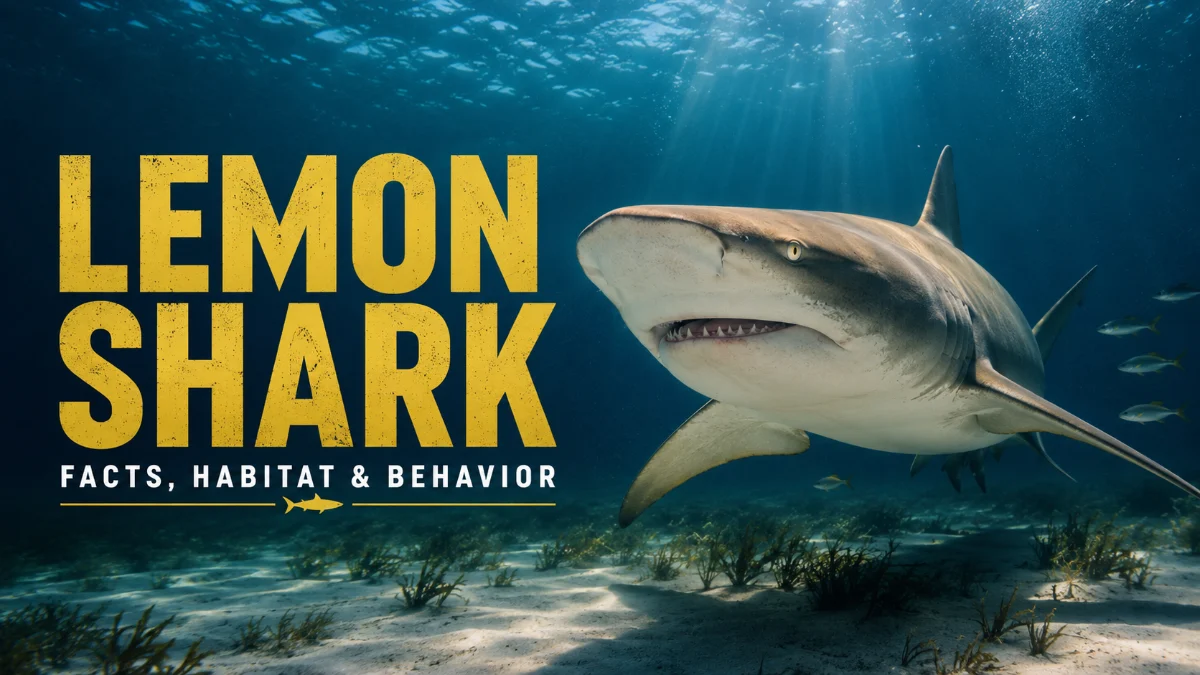
The lemon shark (Negaprion brevirostris) is a large coastal shark found in warm Atlantic and eastern Pacific waters. Adults commonly reach 8–10 feet long, use mangroves and shallow coastal waters as important nursery habitats, and feed mainly on fish, rays, and crustaceans. Although they are powerful predators, lemon sharks rarely pose a threat to people; globally, the species is classified as Vulnerable because of fishing pressure and loss of coastal habitat.
Lemon Shark Quick Facts
| Category | Detail |
| Scientific name | Negaprion brevirostris |
| Family | Carcharhinidae, the requiem sharks |
| Order | Carcharhiniformes |
| Class | Chondrichthyes |
| Subclass | Elasmobranchii |
| Typical adult size | 8–10 feet long |
| Maximum size | About 11 feet |
| Habitat | Mangroves, estuaries, seagrass beds, bays, reefs, and sandy coastal waters |
| Diet | Bony fish, rays, crustaceans, squid, and occasionally smaller sharks |
| Reproduction | Live-bearing; pups develop inside the mother |
| Conservation status | Vulnerable |
| Risk to people | Low; avoid touching, feeding, or crowding any wild shark |
What Is a Lemon Shark?
A lemon shark is a species of requiem shark recognized by its yellow-brown to olive coloration, broad snout, and two dorsal fins that are similar in size. Its scientific name, Negaprion brevirostris, refers specifically to the Atlantic and eastern Pacific species—not the related sicklefin lemon shark of the Indo-Pacific.
The name comes from its color, which helps the shark blend with sandy seabeds, shallow reef areas, and seagrass. This natural camouflage is useful in the coastal environments where it spends much of its life.
Read more: Lemon Shark
Lemon Shark Classification
The species belongs to the cartilaginous fishes, a group that also includes rays, skates, and chimaeras. Unlike bony fish, sharks have skeletons made primarily of cartilage.
| Taxonomic rank | Classification |
| Kingdom | Animalia |
| Phylum | Chordata |
| Class | Chondrichthyes |
| Subclass | Elasmobranchii |
| Order | Carcharhiniformes |
| Family | Carcharhinidae |
| Genus | Negaprion |
| Species | Negaprion brevirostris |
The genus Negaprion has two living members: N. brevirostris and the sicklefin lemon shark, N. acutidens. The latter lives primarily in Indo-Pacific waters and should be treated as a separate species in identification and conservation discussions.
Identification and Lemon Shark Size
Lemon sharks have a stocky, streamlined body suited to active coastal swimming. Their upper body is generally yellowish-brown, tan, or olive, while the underside is paler. Color alone is not enough for identification because light, water clarity, and background can change how a shark appears underwater.
The clearest field marks include:
- A short, broad, flattened snout.
- A robust body with large pectoral fins.
- Yellow-brown to olive upper coloration.
- Two dorsal fins that are nearly equal in size.
- Smooth teeth with a central cusp and small serrations.
Adults are usually 8–10 feet long, and the largest recorded individuals reach around 11 feet. Females generally grow larger than males. Young sharks are much smaller at birth and remain in protected shallow habitat during their early development.
Lemon Shark Habitat and Range
Lemon sharks live mainly in warm, shallow coastal environments rather than deep offshore water. Their preferred habitats include mangroves, seagrass beds, estuaries, river mouths, coral reefs, lagoons, bays, and sandy continental shelves.
The species occurs in parts of the western Atlantic, including the southeastern United States, Gulf of Mexico, Caribbean, and coastal South America. It is also found along parts of West Africa and the eastern Pacific, from Baja California south to Ecuador.
Why mangroves and seagrass matter
Mangroves and seagrass beds are essential shark nursery habitats. Their shallow, protected waters offer young sharks abundant prey and reduce contact with some larger predators. Complex mangrove root systems also provide cover, while nearby seagrass supports small fish and invertebrates.
Young lemon sharks often show strong site fidelity, remaining near the nursery area where they were born for extended periods. Some adult females also return to specific nursery regions to give birth, making the protection of these local ecosystems especially important.
What Do Lemon Sharks Eat?
Lemon sharks are opportunistic predators whose diet changes as they grow. Juveniles eat smaller fish and invertebrates, while adults can take larger fish, rays, and other coastal prey.
Their diet may include:
- Bony fish such as mullet, jacks, grunts, and snappers.
- Rays and other bottom-associated fishes.
- Crabs, shrimp, and other crustaceans.
- Squid and other cephalopods.
- Smaller sharks on occasion.
These sharks often feed most actively at dusk, during the night, or in low-light coastal conditions. They use several senses to locate prey, including smell, vision, hearing, vibration detection, and electroreception.
Lemon Shark Behavior and Adaptations
Lemon sharks are active coastal predators, but they are also among the more social shark species studied. Juveniles may gather in loose groups in nursery habitats, and individuals can show repeated associations with familiar sharks. These gatherings are not coordinated hunting packs; they are flexible social aggregations shaped by food, shelter, safety, and local conditions.
Adaptations for shallow-water survival
Several traits help this species thrive in coastal environments:
- Camouflage: Yellow-brown coloration helps it blend with sand, mud, and seagrass.
- Electroreception: Ampullae of Lorenzini detect weak electrical fields produced by prey, including animals hidden in sediment.
- Lateral-line sensing: Detects vibrations and pressure changes in water.
- Broad teeth and strong jaws: Help capture fish, rays, and other mobile prey.
- Brackish-water tolerance: Allows use of estuaries and river mouths, though the species is not known for long-distance travel into freshwater.
- Nursery-habitat use: Young sharks gain food and partial protection in mangrove and seagrass ecosystems.
As they mature, many individuals expand beyond their natal nursery areas. Adults can make seasonal movements along coastal shelves in response to changing water temperature, prey availability, and reproductive activity.
Reproduction and Life Cycle
Lemon sharks are live-bearing. After the embryo uses its initial yolk supply, it receives nourishment through a placenta-like connection with the mother. This reproductive strategy is called placental viviparity.
Females usually give birth in shallow coastal nursery areas. Pups are born alive and receive no parental care after birth. Their survival depends on finding food, avoiding larger predators, and using sheltered habitat effectively.
Important life-cycle traits include:
- A gestation period of roughly 10–12 months.
- Litters commonly ranging from 4 to 17 pups.
- A reproductive cycle that may occur every other year.
- Sexual maturity reached after many years of growth.
- Long-term dependence on productive coastal nursery habitat.
This slow life history makes populations sensitive to sustained fishing pressure. A species that matures later and produces relatively few young cannot quickly replace adults removed from the population.
Lemon Shark vs. Bull Shark vs. Nurse Shark
Lemon sharks are often confused with other sharks that occur in warm coastal waters. The following table highlights practical differences.
| Feature | Lemon shark | Bull shark | Nurse shark |
| Family | Carcharhinidae | Carcharhinidae | Ginglymostomatidae |
| Scientific name | Negaprion brevirostris | Carcharhinus leucas | Ginglymostoma cirratum |
| Main habitat | Coastal marine waters, mangroves, estuaries, reefs | Coastal waters, estuaries, and freshwater rivers | Tropical reefs, sandy flats, ledges, and shallow coastal areas |
| Freshwater tolerance | Uses brackish water but does not typically travel far upriver | Can live and travel far into freshwater | Primarily marine |
| Body profile | Yellow-brown, broad snout, two similarly sized dorsal fins | Robust gray body, wide snout, much larger first dorsal fin | Broad head, barbels beside mouth, rounded fins |
| Typical feeding style | Active predator of fish, rays, and crustaceans | Opportunistic predator with a broad diet | Bottom feeder that often uses suction |
| Human interaction risk | Low, but still a wild predator | Greater caution is warranted | Usually low, though defensive bites can occur if handled |
| Global conservation status | Vulnerable | Vulnerable | Vulnerable |
Where Can You See Lemon Sharks?
Lemon sharks occur across broad tropical and subtropical coastal ranges, but reliable sightings depend on local seasons, water conditions, and protected habitat. They are regularly documented in several areas:
- Bimini, Bahamas: Known for mangrove nursery research and encounters with juvenile sharks.
- Jupiter, Florida: Seasonal offshore aggregations can occur during winter months.
- Florida Keys and nearby coastal waters: Sightings are possible in suitable shallow marine habitat.
- Caribbean reefs and bays: Adults may be found around sandy bottoms, reef edges, and lagoons.
- Gulf of Mexico: Coastal areas can support the species, particularly around productive nearshore habitat.
- Eastern Pacific coasts: The species is found from Baja California south toward Ecuador.
Wildlife encounters should always be conducted responsibly. Local regulations, seasonal access, visibility, weather, and animal movement can change, so a particular sighting location is never guaranteed.
Are Lemon Sharks Dangerous to Humans?
Lemon sharks are not generally considered a major threat to people. Unprovoked bites are rare, and fatalities attributed to this species are not known. However, this should not be interpreted as a guarantee of safety.
Any shark can bite defensively if it is hooked, handled, cornered, fed, disturbed, or unable to move away. The safest approach is to observe from a respectful distance, avoid sudden pursuit, and never attempt to touch or feed a wild shark.
Common Lemon Shark Misconceptions
- “Lemon sharks are aggressive toward people.” They are large predators, but they are not typically associated with frequent unprovoked incidents involving humans.
- “They live in freshwater like bull sharks.” They may enter brackish estuaries and river mouths, but they are primarily marine sharks and do not regularly travel far upriver.
- “All lemon sharks move in the same way.” Juveniles often remain near nursery habitat, while adults may make broader seasonal movements.
- “A shark seen often at a dive site must be common everywhere.” Frequent sightings at a few locations do not reveal the health of the global population.
- “Their yellow color is always obvious.” Underwater light and background conditions can make them appear gray, brown, or olive rather than distinctly yellow.
Ecological Role
Lemon sharks are upper-level predators in coastal food webs. By feeding on fish, rays, and invertebrates, they connect mangrove, seagrass, reef, and estuarine ecosystems. Their presence can influence prey movement and feeding behavior, helping shape the ecological relationships within shallow-water habitats.
Their ecological importance also reflects their reliance on connected habitat. Juveniles may depend on mangroves and seagrass while adults use reefs, bays, and continental shelves. Protecting only one habitat type is less effective than conserving the coastal network that supports the species throughout its life cycle.
Conservation Status and Threats
The lemon shark is classified as Vulnerable on the IUCN Red List. Its conservation challenges are linked to the species’ slow growth, late maturity, relatively small litters, fishing pressure, and dependence on shallow coastal nurseries.
The main threats include:
- Targeted fishing for meat, fins, and other products.
- Accidental capture in longline, net, and coastal fisheries.
- Mortality after recreational catch-and-release when handling is poor.
- Mangrove clearance and degradation of estuaries.
- Coastal development, dredging, pollution, and sediment runoff.
- Seagrass loss and damage to shallow feeding grounds.
- Entanglement in discarded or lost fishing gear.
In some parts of the United States, harvest protections and fishing restrictions have been introduced to reduce pressure on coastal shark populations. Long-term recovery still depends on effective fisheries management and the protection of nursery habitat.
How to Help Protect Lemon Sharks
People can support shark conservation through choices that reduce pressure on marine ecosystems and improve the quality of wildlife interactions.
- Follow local shark-fishing regulations and species-specific release rules.
- Avoid purchasing shark-fin products and wildlife products from unknown or illegal sources.
- Choose seafood from well-managed, traceable fisheries where possible.
- Support mangrove, seagrass, reef, and estuary restoration initiatives.
- Do not feed, touch, chase, or crowd sharks while diving or snorkeling.
- Report entangled or injured wildlife to local marine authorities rather than attempting unsafe rescues.
- Share accurate information about sharks and avoid fear-based myths.
Frequently Asked Questions
Can lemon sharks swim in groups?
Yes. Juvenile lemon sharks are often seen in loose groups within nursery habitats, and adults may also gather in particular locations. These associations are not permanent packs with coordinated roles. Instead, sharks may remain near one another because the same habitat offers shelter, food, suitable temperature, or access to breeding areas. Some research suggests individuals can show repeated associations with familiar sharks over time.
How fast can lemon sharks swim?
Lemon sharks are built for steady coastal swimming and short bursts when hunting rather than extreme speed. A precise, verified top speed is not well established, so published speed figures should be treated cautiously. Their hunting success depends on camouflage, approach angle, electroreception, and rapid acceleration at close range, not simply on being the fastest shark in the water.
Do lemon sharks migrate?
Many adult lemon sharks make seasonal coastal movements, often following water temperature, prey, and reproductive conditions. Juveniles usually show much stronger attachment to nursery areas and may remain close to where they were born for years. Migration patterns are not identical across the full range because local water conditions, food availability, and habitat connectivity differ from one region to another.
How long do lemon sharks live?
Lemon shark lifespan is generally estimated at about 25–30 years in the wild, although determining exact age in free-ranging sharks is difficult. Some individuals may live longer. Their long lifespan, delayed maturity, and relatively low reproductive output mean that population losses can take many years to replace, especially when adult sharks are removed faster than the population can recover.
What eats lemon sharks?
Large adult lemon sharks have few natural predators, although humans are the most significant source of mortality through fishing and bycatch. Juveniles are more vulnerable and may be eaten by larger sharks. Young sharks use shallow mangroves, estuaries, and seagrass habitats partly because these areas may reduce encounters with larger predators while also providing enough food for growth.
Can lemon sharks survive in captivity?
Lemon sharks have been kept in aquariums and studied in controlled settings because they can tolerate captivity better than some shark species. However, they require large, carefully managed marine systems with appropriate water quality, space, veterinary care, and feeding. Captivity is not suitable for private ownership and should be limited to qualified institutions that can meet the animal’s long-term welfare needs.
Why is the lemon shark classified as Vulnerable?
The species is classified as Vulnerable because fishing pressure and habitat degradation have reduced its resilience in many parts of its range. Lemon sharks grow slowly, mature after many years, and produce relatively few pups compared with many bony fishes. When adult sharks are removed and mangrove nursery habitat is lost, populations may decline faster than they can recover.
Are lemon sharks the same as sicklefin lemon sharks?
No. The lemon shark is Negaprion brevirostris, found mainly in Atlantic and eastern Pacific waters. The sicklefin lemon shark is Negaprion acutidens, a related Indo-Pacific species. Both belong to the same genus and share some physical traits, including yellow-brown coloration, but they have different ranges, local habitats, and conservation needs.
Do lemon sharks return to the same place to give birth?
Some females show natal philopatry, meaning they return to the broader nursery region where they were born to give birth. This pattern has been documented in well-studied coastal populations. It makes nursery protection particularly important because damage to a specific mangrove or estuarine system may affect the reproductive success of sharks that repeatedly use that area across generations.
What is the best time of year to see lemon sharks in Florida?
Seasonal aggregations have been observed off Jupiter, Florida, during winter, often from approximately December through March. Timing can shift with water temperature, prey movement, storms, and yearly conditions. Sightings in other parts of Florida may follow different seasonal patterns. Anyone planning a wildlife encounter should check current conditions with qualified local operators and follow practices that do not disturb the sharks.