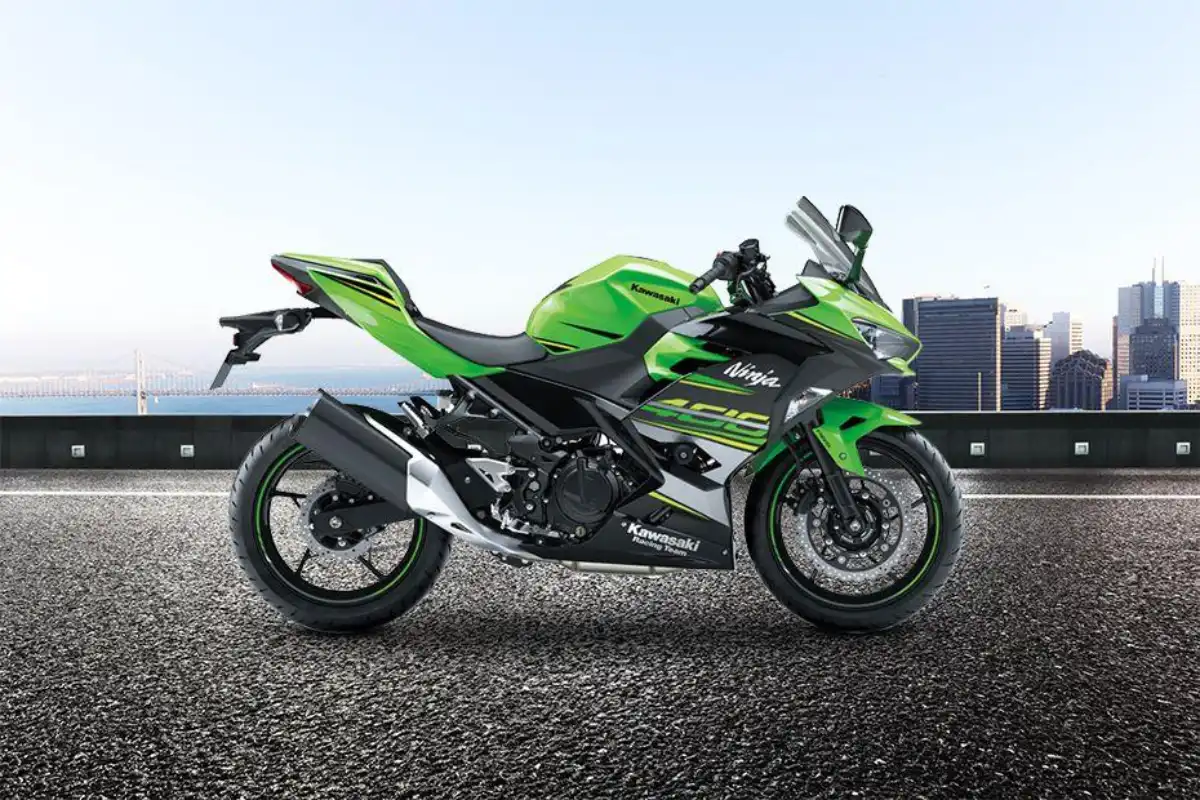
The Kawasaki Ninja 400 built its reputation as one of the most capable entry-level sport bikes ever sold, pairing genuine track-day performance with handling forgiving enough for new riders. It’s important to know upfront that Kawasaki discontinued the model in India in May 2024, and in the United States after the 2023 model year, replacing it with the larger-engined Ninja 500. New units are no longer sold through authorized dealers, so this guide is written primarily for buyers evaluating it on the used market, while also weighing it against its direct successor and closest rivals.
Here’s the quick-reference spec sheet before the deeper buying analysis:
| Spec | Detail |
| Engine | 399cc liquid-cooled parallel-twin, DOHC, 8-valve |
| Power / Torque | 45 PS @ 10,000 rpm / 37 Nm @ 8,000 rpm |
| Gearbox | 6-speed, wet slipper/assist clutch |
| Kerb weight | 168 kg |
| Seat height | 785 mm |
| Fuel tank / mileage | 14 litres / roughly 24-27 kmpl claimed |
| Brakes | 310mm front, 220mm rear disc, dual-channel ABS |
| Last India price | Rs 5.24 lakh ex-showroom (discontinued) |
Engine and Performance
The parallel-twin uses a 70.0mm x 51.8mm bore and stroke with an 11.5:1 compression ratio, sending power through a six-speed gearbox fitted with a slipper clutch that smooths downshifts under hard braking. It’s quick off the line for its class, covering 0-96 km/h in roughly 4.1 to 4.35 seconds — enough to out-accelerate most naturally aspirated rivals in the same segment. Kawasaki never published an official top speed figure; independent testing consistently places the machine around 170-186 km/h depending on rider weight and conditions.
Read more: Ninja 400
Fuel Efficiency and Everyday Costs
Claimed efficiency figures range from 24 to nearly 27 kmpl, with real-world city riding typically landing at 22-24 kmpl and highway cruising closer to 27-28 kmpl on the 14-litre tank. A five-year ownership model based on 100 km of daily riding estimates total costs of around Rs 12.65 lakh, split roughly into Rs 3.14 lakh depreciation, Rs 1.18 lakh servicing, Rs 6.98 lakh fuel, and Rs 1.36 lakh insurance. These figures shift with local fuel prices and insurer, so treat them as directional rather than fixed.
Maintenance Schedule
Kawasaki’s factory service intervals keep the twin-cylinder engine relatively simple to maintain compared with inline-four sportbikes in the same price range:
| Service Item | Interval |
| Engine oil and filter | Every 12,000 km or 1 year |
| Valve clearance check | Every 24,000 km (15,000 miles) |
| Spark plugs | Every 12,000-24,000 km |
| Coolant replacement | Every 36,000 km (3 years) |
| Air filter element | Every 48,000 km, sooner in dusty conditions |
| Brake fluid | Every 2 years |
| Chain lubrication | Every 500-800 km, adjusted as needed |
Independent workshop estimates for a valve clearance check typically run in the $150-350 range depending on region and labor rates.
Reliability and Common Problems
Kawasaki issued a factory recall for 2020-2021 model-year Ninja 400 and Z400 units over a cam-chain tensioner manufactured with insufficient strength, which could cause engine noise or, in rare cases, stalling. Affected owners received a free tensioner replacement, so confirming this repair on any used unit from that production window should be a non-negotiable step before purchase.
Beyond the recall, specialist buyer guides and owner reports flag two recurring issues worth checking: premature clutch slip on some 2019-2023 units, occasionally appearing within the first few thousand kilometers, and water-pump seal seepage on bikes ridden hard or tracked frequently, visible as coolant staining near the pump cover. Neither problem is universal, and no broader engine or gearbox recall exists beyond the tensioner fix.
Used Buying Checklist
Work through this list in person before finalizing any purchase:
- Verify the VIN against service records and confirm the cam-chain tensioner recall was completed on 2020-2021 models.
- Cold-start the engine and listen for rattling or knocking before it fully warms up.
- Check for clutch slip by holding steady throttle in a higher gear and feeling for power delivery lag.
- Confirm the ABS warning light switches off correctly after startup.
- Inspect the frame and fork for signs of misalignment or prior impact damage.
- Check fork seals for oil leakage along the stanchions.
- Look for coolant residue near the water pump cover.
- Check tire age using the DOT date code rather than tread depth alone.
- Measure brake rotor thickness against minimum spec.
- Inspect the chain for excessive slack, rust, or tight spots.
- Request complete service records, especially proof of the 24,000 km valve clearance check.
- Note any aftermarket exhaust, tune, or suspension modifications, since these can affect resale and warranty status.
Ninja 400 vs Ninja 500: Feature Comparison
| Feature | Ninja 400 | Ninja 500 |
| Engine | 399cc twin, 45 PS / 37 Nm | 451cc twin, ~45 PS / 42.6 Nm |
| Display | Analog plus LCD combo | Full digital LCD with updated graphics |
| Smartphone connectivity | Not available | Available via Kawasaki’s Rideology app |
| Kerb weight | 168 kg | ~172 kg |
| Emissions compliance | BS6 Phase 1/2, depending on year | BS6 Phase 2 / Euro 5 |
| India price | Rs 5.24 lakh (discontinued) | Rs 5.66-5.76 lakh |
| Warranty and parts | Limited new-unit support | Full manufacturer warranty and active parts pipeline |
The newer model carries more low-end torque and updated electronics, making it the stronger pick for buyers who want factory warranty and guaranteed parts support rather than saving money on a used bike.
How It Compares to Rival Sport Bikes
| Model | Engine | Power | Torque | Kerb Weight | Approx. Price (India) |
| Kawasaki Ninja 400 | 399cc twin | 45 PS | 37 Nm | 168 kg | Rs 5.24 lakh (discontinued) |
| Kawasaki Ninja 500 | 451cc twin | ~45 PS | 42.6 Nm | 172 kg | Rs 5.66-5.76 lakh |
| Yamaha R3 | 321cc twin | 42 PS | 29.5 Nm | 169 kg | Rs 3.59 lakh |
| KTM RC 390 | 373cc single | 43.5 PS | 37 Nm | 172 kg | Rs 3.23 lakh |
| Aprilia RS 457 | 457cc twin | 47.6 PS | 43.5 Nm | 175 kg | Rs 4.26-4.41 lakh |
| TVS Apache RR 310 | 312cc single | 38 PS | 29 Nm | 174 kg | Rs 2.62-3.15 lakh |
| Kawasaki Ninja ZX-4R | 399cc inline-four | 77 PS | 39 Nm | Higher-tier | Rs 8.49-9.4 lakh |
| Honda CBR500R | 471cc twin | 47-48 hp | 43 Nm | 191 kg | Not officially sold in India |
| CFMoto 450SR | 449cc twin | ~51.6 PS | 40 Nm | 179 kg | India launch and pricing unconfirmed |
Against the Yamaha R3, this Kawasaki held a clear power and refinement edge thanks to its larger twin-cylinder engine, though at a meaningful price premium. The KTM RC 390’s single-cylinder unit delivers sharper mid-range punch and a more track-focused riding position, while the smoother twin favors long, sweeping corners. The Aprilia RS 457 undercuts what this bike used to cost while offering more power and torque, making it a strong alternative for anyone shopping new rather than used. The ZX-4R, meanwhile, sits in a different tier entirely — a homologation-special inline-four aimed at serious track riders rather than a direct replacement — while the Apache RR 310 remains the strongest budget option for India-based buyers.
Who Should Buy It, and Who Should Skip It
Best for: new riders progressing from a 150-250cc machine, weekend canyon or track-day riders who value a light chassis, and commuters who want sporty ergonomics without an intimidating power delivery.
Not ideal for: two-up touring, since the pillion seat and light chassis aren’t built for sustained highway loads with a passenger; riders taller than roughly 185 cm, who may find the compact ergonomics cramped; and anyone chasing maximum outright performance, where the Aprilia RS 457 or Ninja ZX-4R offer considerably more.
Ownership Beyond the Showroom
Insurance premiums on sport bikes generally run higher than on commuter motorcycles due to theft and accident-risk pricing models, so get a quote against your specific city and rider profile before finalizing a used purchase.
Resale value has softened faster than it would for an in-production model, since buyers increasingly compare used pricing against a new Ninja 500. Well-maintained, low-mileage units with complete service records and confirmed recall repairs retain value noticeably better than average examples.
Spare parts for consumables like brake pads, chains, and filters remain widely available through Kawasaki’s dealer network, though body panels and platform-specific electronics may take longer to source as the model ages out of production. Post-2021 units, once the cam-chain tensioner recall was resolved at the factory, are generally the safer buy among used examples. The most common modifications seen on the used market are aftermarket exhausts, adjustable levers, and tail-tidy kits; if a unit has an ECU tune, verify it was done by a reputable shop, since poor tunes can undermine reliability.
Pros and Cons
Pros
- Strong twin-cylinder performance for its class, with smoother delivery than single-cylinder rivals
- Light 168 kg kerb weight that stays approachable for beginners
- Straightforward, twin-cylinder maintenance compared with inline-four competitors
- Comfortable 785mm seat height suited to shorter riders
Cons
- Discontinued, with no new-unit warranty or dealer network priority
- Costs more than the Apache RR 310 or KTM RC 390 for comparable used condition
- Documented recall on early units requires verification before purchase
- Not designed for two-up touring or long highway hauls
Frequently Asked Questions
Is the Kawasaki Ninja 400 worth buying in 2026?
It’s worth buying if you find a well-documented used unit at a fair discount to the Ninja 500’s current price, especially if you value the lighter chassis and smoother twin-cylinder engine. If parts availability and factory warranty matter more, the Ninja 500 is the safer long-term choice.
How reliable is it overall?
Reliability is considered solid for the segment, with one documented recall for a cam-chain tensioner issue on 2020-2021 units. Some owners report clutch slip or coolant seepage on hard-ridden bikes, but these issues aren’t universal and mostly affect track-used examples.
What are the most common problems to watch for?
The most notable documented issue is the cam-chain tensioner recall on 2020-2021 models. Less formally documented owner reports mention occasional clutch slip, water-pump seal seepage on aggressively ridden units, and false neutrals between second and third gear during hard upshifts.
What mileage is considered too high on a used unit?
There’s no fixed cutoff, but examples well past 40,000-50,000 km should have documented valve clearance checks and clutch inspections, since these are the components most affected by high-mileage or aggressive use.
Which model year is the safest to buy used?
Units from 2021 onward that have confirmed the cam-chain tensioner recall repair are generally the safer choice, since this eliminates the primary documented reliability concern on the platform.
Is it expensive to maintain?
Maintenance costs are moderate for the segment, with oil changes every 12,000 km and valve checks every 24,000 km. Independent shop estimates for valve clearance service run roughly $150-350, making annual costs comparable to other 300-500cc sport bikes.
Can beginners ride it safely?
Yes, it’s widely recommended for new riders due to its light weight, smooth power delivery, and manageable seat height, though first-time riders should still complete a formal training course regardless of which bike they choose.
Is it good for touring?
It suits short trips and spirited weekend rides better than long-distance touring, since the compact ergonomics, small fuel tank, and firm suspension aren’t optimized for extended highway comfort or two-up loads.
Is the Ninja 500 worth the extra money over a used example?
For buyers who want factory warranty, guaranteed parts availability, and updated electronics like a full digital display, the price premium is generally justified. Buyers prioritizing a lower purchase price who are comfortable with used-market risk may still prefer the older bike.
Does it need special insurance considerations?
Sport bikes generally carry higher insurance premiums than commuter motorcycles due to theft and accident-risk models used by insurers. Get quotes based on the specific bike’s registration year and your rider profile before finalizing a purchase.