The axial skeleton forms the central framework of the human skeletal system and contains 80 bones in a typical adult. It includes the skull, auditory ossicles, hyoid bone, vertebral column, and thoracic cage. Together, these structures support the head and trunk, protect the brain and spinal cord, help shield vital organs in the chest, and provide attachment points for muscles involved in posture, movement, and breathing.
The axial division works alongside the appendicular skeleton, which contains 126 bones. Together, they make up the typical adult skeleton of 206 bones. While the appendicular division primarily enables limb movement, the axial division provides the body’s central support and protection.
What Is the Axial Skeleton?
The axial skeleton is the portion of the skeletal system that runs along the body’s central axis, extending from the head through the neck and trunk. Its main structures include the skull, spinal column, and rib cage.
Unlike the bones of the arms and legs, which are especially important for movement, these central bones form a protective framework around vital organs and nervous tissue.
The axial division of the skeletal system also provides attachment points for muscles that stabilize the head, maintain upright posture, move the trunk, and assist with breathing.
How Many Bones Are in the Axial Skeleton?
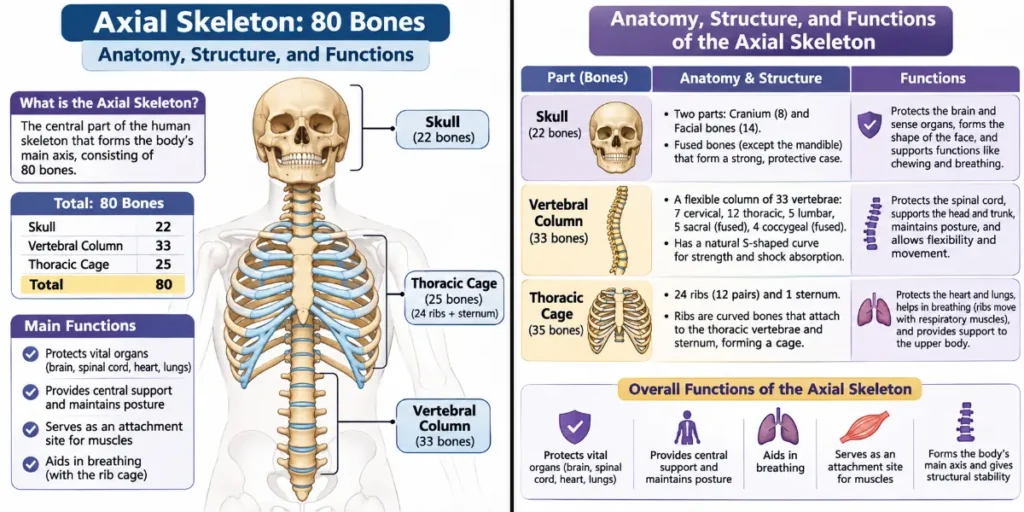
A typical adult axial skeleton contains 80 bones, organized into five anatomical groups.
| Component | Number of Bones | Main Role |
| Skull | 22 | Protects the brain and supports facial structures |
| Auditory ossicles | 6 | Transmit sound vibrations |
| Hyoid bone | 1 | Supports the tongue and swallowing muscles |
| Vertebral column | 26 | Supports the trunk and protects the spinal cord |
| Thoracic cage | 25 | Protects thoracic organs and assists breathing |
| Total | 80 | Support, protection, and stability |
These numbers represent the standard adult bone count. Some bones fuse as the body matures, and individual anatomical variations can occur. Costal cartilages and intervertebral discs are not counted as separate bones.
Five Main Parts of the Axial Skeleton
1. Skull – 22 Bones
The skull contains 22 bones divided into two groups:
- Cranial bones (8): Form the cranium, which surrounds and protects the brain.
- Facial bones (14): Give the face its shape and support structures such as the nasal cavity, eye sockets, and jaws.
Most skull bones connect through fibrous joints called sutures, which allow little or no movement. The mandible, or lower jaw, is an exception because it moves during chewing and speaking.
2. Auditory Ossicles – 6 Bones
The auditory ossicles are six tiny bones inside the middle ears, with three in each ear.
They include:
- Malleus (hammer)
- Incus (anvil)
- Stapes (stirrup)
Working together, these bones transmit and amplify sound vibrations from the eardrum toward the inner ear. The stapes is the smallest bone in the human body.
Although the ossicles sit within the temporal bones of the skull, they are counted separately when identifying the axial skeleton’s 80 bones.
3. Hyoid Bone – 1 Bone
The hyoid is a small, U-shaped bone in the front of the neck, just above the larynx.
Unlike most bones, it does not form a direct joint with another bone. Instead, muscles and ligaments hold it in position.
The hyoid provides attachment points for muscles that control tongue movement and help coordinate swallowing and speech.
4. Vertebral Column – 26 Bones
The vertebral column, commonly called the spine or backbone, extends from the skull to the pelvis. It supports the head and trunk while forming a protective canal around the spinal cord.
The adult vertebral column consists of five regions:
| Region | Adult Bone Count | Description |
| Cervical | 7 | Neck vertebrae (C1–C7) |
| Thoracic | 12 | Upper and middle back vertebrae (T1–T12) |
| Lumbar | 5 | Lower back vertebrae (L1–L5) |
| Sacrum | 1 | Formed by five fused sacral vertebrae |
| Coccyx | 1 | Usually formed by four fused coccygeal vertebrae |
| Total | 26 |
The vertebral column initially develops as a series of approximately 33 vertebrae. As the sacral and coccygeal vertebrae fuse during maturation, the standard adult count becomes 26 bones.
Intervertebral discs between most adjacent movable vertebrae cushion the spine, absorb shock, and allow controlled movement.
The spine’s natural curves also help distribute body weight, maintain balance, and support an upright posture.
5. Thoracic Cage – 25 Bones
The thoracic cage, commonly known as the rib cage, contains 24 ribs arranged in 12 pairs and one sternum, or breastbone.
The ribs are classified as true ribs (1–7) and false ribs (8–12). Floating ribs (11–12) are a subgroup of false ribs.
- True ribs (1–7): Connect directly to the sternum through their own costal cartilages.
- False ribs (8–10): Connect indirectly to the sternum through the cartilage of the ribs above.
- Floating ribs (11–12): Have no anterior connection to the sternum.
All 12 pairs of ribs attach posteriorly to the thoracic vertebrae.
The sternum has three main parts: the manubrium, body, and xiphoid process. These are conventionally counted together as one adult bone.
The thoracic cage surrounds and helps protect the heart and lungs. Its flexible connections also allow the rib cage to expand and contract during breathing.
What Are the Main Functions of the Axial Skeleton?
The axial skeleton does more than hold the body upright. Its bones protect delicate structures, support muscle activity, and allow essential movements.
Structural Support and Posture
The vertebral column supports the weight of the head and trunk, transferring much of that load toward the pelvis.
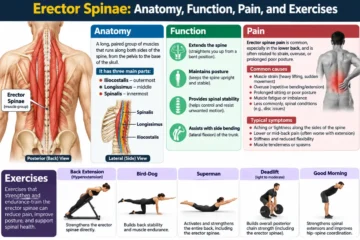
Its natural curves work with the surrounding muscles to maintain balance during standing, sitting, and walking. The erector spinae muscles, which run along both sides of the spine, are especially important for maintaining posture and controlling spinal movement.
Protection of Vital Organs
Several axial structures help protect delicate tissues:
- The cranium surrounds the brain.
- The vertebrae form a protective canal around the spinal cord.
- The rib cage helps shield the heart, lungs, and major blood vessels.
Although these bones provide substantial protection, severe impacts can still damage the structures beneath them.
Muscle Attachment and Movement
Axial bones provide attachment points for muscles that move the head, stabilize the spine, support the tongue, and control trunk movements.
These connections allow muscles to generate movement while keeping the body’s central framework stable.
Breathing Support
During inhalation, the diaphragm contracts and the ribs move upward and outward, increasing the space inside the thoracic cavity.
During normal exhalation, the diaphragm relaxes and the rib cage generally returns toward its resting position, reducing thoracic volume.
The ribs, sternum, thoracic vertebrae, and respiratory muscles work together to make these movements possible.
Axial vs. Appendicular Skeleton: Key Differences
The human skeleton has two major divisions. Although they work together, each has a different anatomical arrangement and primary role.
| Feature | Axial Skeleton | Appendicular Skeleton |
| Location | Head, neck, and trunk | Limbs and their attachment girdles |
| Bone count | 80 | 126 |
| Main components | Skull, ossicles, hyoid, vertebral column, thoracic cage | Shoulder girdles, arms, hands, pelvic girdle, legs, feet |
| Primary function | Support, protection, and stability | Movement, locomotion, and manipulation |
| Examples | Skull, ribs, sternum, vertebrae | Humerus, scapula, hip bone, femur |
One important difference is that the shoulder girdle and pelvic girdle belong to the appendicular skeleton, even though they connect the limbs to the body’s central framework.
Both divisions are essential for activities such as walking, lifting, bending, and maintaining balance. The axial skeleton provides stability, while the appendicular skeleton allows the limbs to carry out a wide range of movements.
Frequently Asked Questions
Why does the vertebral column have 26 bones instead of 33 in adults?
The spine initially develops with approximately 33 vertebrae. As the body matures, five sacral vertebrae fuse into the sacrum, while usually four coccygeal vertebrae fuse into the coccyx. This leaves 24 individual vertebrae, plus the sacrum and coccyx, giving the typical adult spine a total of 26 bones.
Does the axial skeleton include the pelvis?
No. The hip bones that form the pelvic girdle belong to the appendicular skeleton. However, the sacrum and coccyx, which contribute to the posterior wall of the pelvis, are part of the axial skeleton.

0 Comments