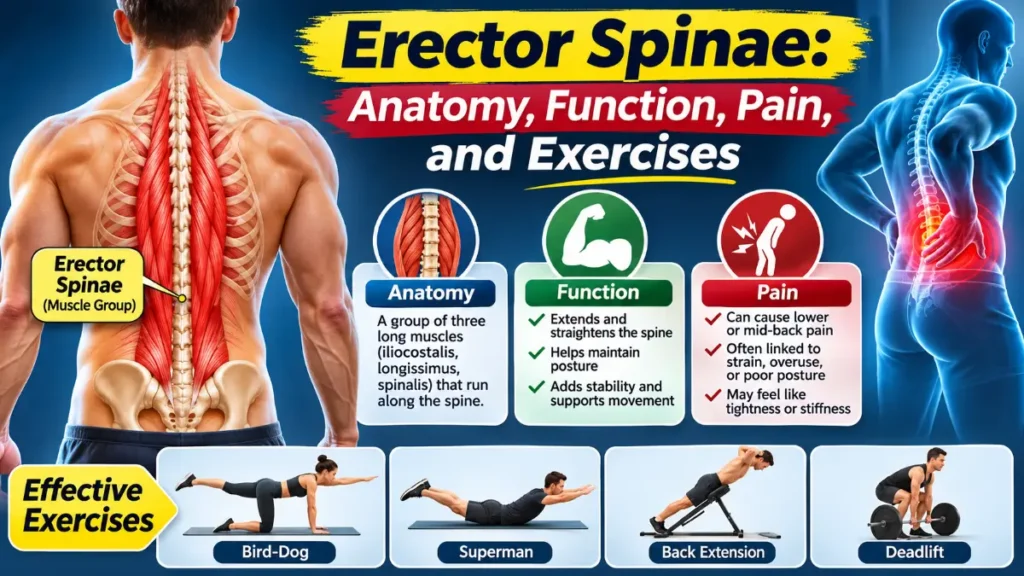
The erector spinae are three paired, longitudinal columns of back muscles that run along either side of the spine. They consist of the iliocostalis, longissimus, and spinalis muscles, which work together to straighten the spine, bend it sideways, and maintain an upright posture. These muscles also help stabilize the trunk during everyday activities such as standing, walking, bending, and lifting.
As part of the intrinsic back muscles, the erector spinae extend from the lower back and pelvic region toward the upper spine, with certain portions reaching the skull.
Erector Spinae Anatomy and Location
The erector spinae muscles lie on both sides of the vertebral column, beneath the more superficial back muscles. They form three columns arranged from lateral (farthest from the spine) to medial (closest to the spine).
Although these muscles share several functions, they differ in their attachments, positions, and regional subdivisions. The anatomy of the erector spinae muscles also includes a segmental nerve supply that allows them to support movement throughout different regions of the back.
Iliocostalis, Longissimus, and Spinalis
| Muscle | Position | Major Attachments | Main Functions | Innervation |
| Iliocostalis | Lateral (outermost) | Iliac crest, sacral region, ribs, and cervical transverse processes | Spinal extension and lateral flexion | Posterior rami of spinal nerves |
| Longissimus | Intermediate (middle) | Pelvic and vertebral structures, ribs, transverse processes, and mastoid process in the head region | Extension, lateral flexion, and head movement | Posterior rami of spinal nerves |
| Spinalis | Medial (innermost) | Primarily vertebral spinous processes, with regional variations | Spinal extension and lateral flexion | Posterior rami of spinal nerves |
Iliocostalis is the outermost column, divided into iliocostalis lumborum, thoracis, and cervicis. Its connections to the ribs and vertebrae allow it to assist with spinal extension and side bending.
Longissimus forms the middle column and includes the thoracis, cervicis, and capitis portions. It extends through much of the back and neck, while its capitis portion reaches the skull and contributes to head movement.
Spinalis runs closest to the vertebral column. It is commonly described in thoracis, cervicis, and capitis regions, although the exact subdivisions can vary between individuals.
All three columns receive nerve supply from the posterior, or dorsal, rami of spinal nerves.
What Do the Erector Spinae Muscles Do?
The main erector spinae function is to extend the vertebral column and help control spinal position during movement. Their actions depend on whether both sides contract together or one side is more active than the other.
Spinal extension: When both sides contract, they help straighten the back from a forward-bent position. This movement occurs when you return to standing after bending down.
Lateral flexion: Contracting predominantly on one side helps bend the trunk in that direction. For example, the right erector spinae contribute to bending your torso toward the right.
Postural support: These muscles help maintain an upright position during standing and sitting, adjusting their activity as your posture changes.
Movement control and stability: During walking, bending, and lifting, they help control spinal movement and resist unwanted forward bending of the trunk.
The erector spinae work with the abdominal muscles, hip muscles, and deeper spinal stabilizers. One important distinction involves the multifidus, which belongs to a deeper muscle group and contributes to controlling movement between individual vertebrae.
While the erector spinae provide substantial support for trunk extension and broader movement control, multifidus plays an important role in segmental spinal stability. Their functions overlap rather than operate independently, as described in deep back muscle anatomy.
Erector Spinae Pain: Causes and Symptoms
Erector spinae pain can develop when the back muscles are strained, overloaded, or irritated during physical activity. However, discomfort along either side of the spine does not necessarily mean these muscles are injured.
Several factors may contribute to muscular discomfort:
- Muscle strain: Sudden or excessive loading can overstretch or damage muscle fibers.
- Repetitive movements: Frequent bending, lifting, or twisting may place repeated demands on the back muscles.
- Unfamiliar exercise: Starting a new workout or increasing exercise intensity too quickly can lead to temporary soreness.
- Prolonged positioning: Spending long periods in the same position may contribute to stiffness or discomfort.
Symptoms may include localized aching, tenderness, muscle tightness, or discomfort when bending and straightening the back. Some people also notice soreness following demanding physical activity.
These symptoms are not unique to the erector spinae. Other muscles, spinal joints, discs, and nerves can produce similar discomfort, making self-diagnosis unreliable.
When to seek medical care: Arrange a medical assessment if back pain persists, worsens, or significantly interferes with daily activities. Seek emergency medical attention for new bladder or bowel dysfunction, loss of sensation around the groin, or significant neurological symptoms. Back pain following major trauma also requires urgent evaluation. These precautions reflect established back pain warning signs.
Erector Spinae Exercises and Stretches
Erector spinae exercises can help build back strength, muscular endurance, and better control of spinal movement. Progress gradually and choose movements that feel comfortable rather than pushing through pain.
Strengthening Exercises
1. Bird Dog
The bird dog engages the back extensors, abdominal muscles, and glutes while challenging trunk stability. It is also included in established spine-conditioning exercises.
- Start on your hands and knees, keeping your spine comfortably neutral.
- Slowly extend one arm forward and the opposite leg backward.
- Keep your hips level without excessively arching your lower back.
- Return to the starting position and repeat on the opposite side.
Focus on smooth, controlled movement rather than lifting your arm or leg as high as possible.
2. Controlled Back Extension
Back extensions strengthen muscles responsible for straightening and supporting the spine. A gentle prone back extension can be a suitable beginner variation when performed comfortably.
- Lie face down on a firm, comfortable surface with your arms beside your body.
- Gently engage your abdominal muscles and lift your upper chest slightly off the surface.
- Keep your neck aligned with your spine, avoiding excessive lower-back arching.
- Slowly lower your chest and repeat within a comfortable, pain-free range.
Begin with a small movement. There is no need to lift your chest high off the floor, especially when learning the exercise.
3. Hip-Hinge Exercise
A hip hinge teaches you to bend at the hips while maintaining control of your trunk. The erector spinae help stabilize the spine as the hips move.
- Stand with your feet approximately hip-width apart.
- Keep your spine comfortably neutral and bend your knees slightly.
- Push your hips backward while allowing your upper body to lean forward.
- Return to standing by extending your hips.
Practice without weights until the movement feels natural. Resistance can be added gradually when appropriate, provided you can maintain control without discomfort.
Stretching and Mobility
Gentle mobility exercises may ease feelings of stiffness and make everyday movement more comfortable. However, no single stretch isolates every part of the erector spinae.
Gentle knee-to-chest movement:
- Lie on your back with your knees bent.
- Slowly bring one knee toward your chest.
- Hold it gently within a comfortable range.
- Lower your leg and repeat on the opposite side.
This movement stretches tissues around the lower back and hip, although it does not specifically isolate the erector spinae.
Avoid bouncing, forcing a stretch, or continuing any movement that increases pain. If you have a recent injury, significant discomfort, or neurological symptoms, seek individualized medical guidance before beginning an exercise routine.
Read also: Transitional Epithelium: Structure, Location, Function, and Histology
Frequently Asked Questions
Can erector spinae muscles become sore after exercise?
Yes. Unfamiliar or strenuous exercise can cause delayed-onset muscle soreness (DOMS), which typically begins 12–24 hours after activity and may peak within 24–72 hours. This soreness usually improves gradually. Sharp pain, substantial weakness, or symptoms that continue worsening should not automatically be dismissed as ordinary post-workout soreness.
How long does an erector spinae strain take to heal?
Recovery varies depending on the severity of the strain, general health, and physical activity demands. Mild muscle strains may begin improving within days and recover over several weeks, while more significant injuries can take longer. This is only a general estimate, not a guaranteed timeline for an erector spinae injury. Seek medical advice if pain persists or worsens.
Should you stretch or strengthen the erector spinae when they hurt?
The safest approach depends on what is causing the discomfort. Gentle movement may help with mild muscular stiffness, while strengthening can be introduced gradually as symptoms and movement tolerance improve. Avoid stretching through sharp pain or performing exercises that worsen your symptoms. Persistent, severe, or unexplained pain warrants professional assessment.


0 Comments