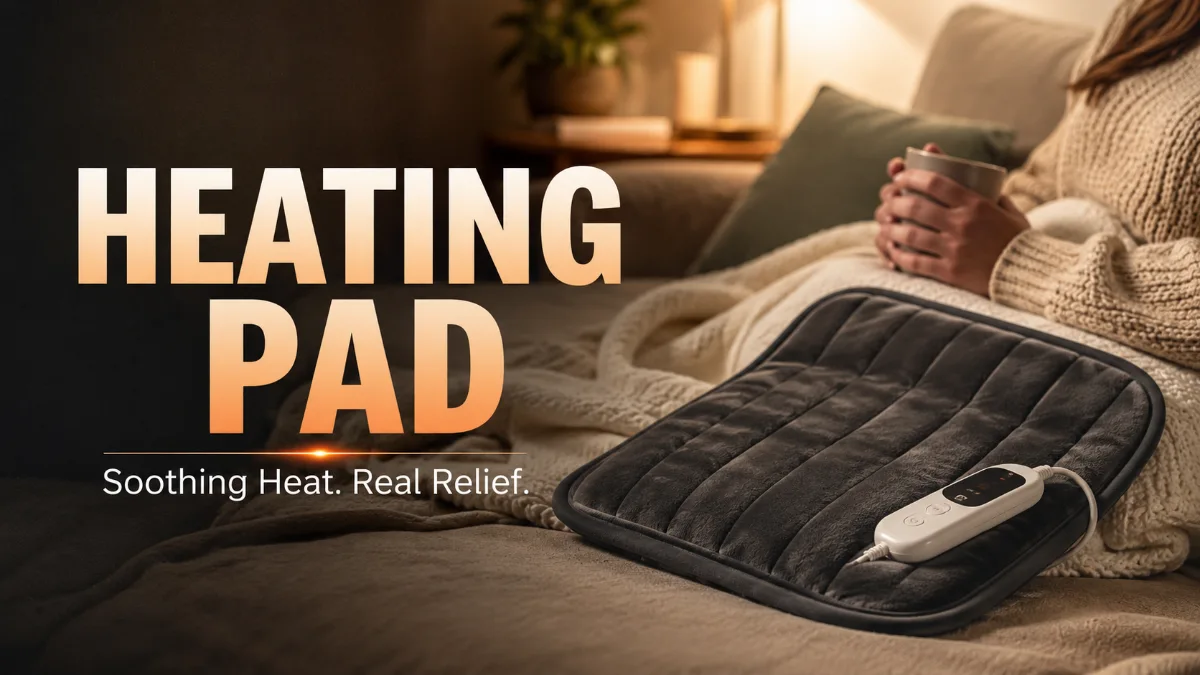
A heating pad applies localized, superficial warmth to the body. It may provide temporary comfort for muscle stiffness, tension, some nonspecific back pain, and menstrual cramps, but it does not treat the cause of severe, persistent, or unexplained pain.
| Question | Short answer |
| What is it? | A device that provides localized superficial heat |
| What can it help with? | Temporary comfort from stiffness, tension, and some cramps |
| How hot should it be? | Comfortably warm—not painful, burning, or difficult to tolerate |
| How long should it be used? | Follow the product instructions and use short, supervised sessions |
| Can you sleep with it? | No—do not sleep with an electric model |
| When should heat be avoided? | On numb, broken, infected, or markedly swollen skin, and for concerning symptoms |
What a Heating Pad Does
This device is a form of superficial heat therapy. It warms the skin and tissue near the body’s surface, which may reduce the feeling of stiffness, relax tense muscles, and make gentle movement more comfortable.
A consumer device is not identical to every heat intervention evaluated in research. Studies may assess disposable heat wraps, hot-water bottles, thermal packs, heated blankets, or other forms of local heat. Findings from those interventions can inform practical choices, but they do not prove that every electric model, temperature setting, session length, or body area will produce the same result.
How localized heat works
Its role is short-term symptom relief rather than tissue repair.
- The device transfers warmth to the skin and superficial tissues.
- Local warmth can affect sensory input and reduce the perceived intensity of stiffness or discomfort.
- Greater comfort may make it easier to rest, change position, walk, or complete gentle mobility exercises.
It does not diagnose pain, repair an injury, resolve nerve compression, or treat conditions such as infection, endometriosis, inflammatory disease, or other medical causes of pain.
Read more: Heating Pad
Regulatory context
In the United States, powered heating pads are classified by the FDA as Class II medical devices under 21 CFR 890.5740. That classification does not mean every product is risk-free, individually FDA-approved for every claimed use, or suitable for every user.
Evidence and practical takeaways
| Use or situation | Evidence or practical takeaway | Important limitation |
| Primary menstrual cramps | Heat therapy is likely to reduce pain intensity | Studies use different heat methods, not only electric pads |
| Acute or subacute nonspecific low-back pain | Certain continuous low-level heat wraps may offer small, short-term relief | Results are not consistent across every study, device, or outcome |
| Muscle tightness and stiffness | Local warmth may provide temporary comfort | Benefit varies by cause and person |
| Chronic unexplained pain | Heat may ease symptoms temporarily | It does not address the cause |
| New swelling or bruising | Cold may provide more comfortable symptom relief | This is not a universal injury-treatment protocol |
| Reduced sensation | Heat requires extra caution | A developing burn may not be noticed |
For primary dysmenorrhea, a 2026 systematic review and meta-analysis included 57 randomized controlled trials involving 5,359 participants. It found that heat therapy was likely to reduce menstrual-pain intensity compared with no treatment, although certainty varied across comparisons and interventions.
Evidence for acute or subacute nonspecific low-back pain is more limited and mixed. A Cochrane review found moderate-quality evidence from two trials that continuous low-level heat wraps produced a small, short-term reduction in pain and disability. This evidence applies to specific wrap protocols, not automatically to all consumer devices. A 2026 randomized trial found no significant disability benefit from heatwrap alone compared with sham heatwrap at one week. The most accurate interpretation is that local heat may provide short-term comfort for some people, rather than a consistent benefit for all users or outcomes.pubmed.ncbi.nlm.nih+2
Types of Heating Pads and Heat Devices
The best option depends on where you intend to use it, whether portability matters, and whether you can safely monitor temperature and skin sensation.
| Type | Best suited to | Advantages | Main limitations |
| Electric heating pad | Home use while seated or reclining | Adjustable settings and reusable warmth | Electrical and burn risks; do not sleep with it |
| Microwavable heat pack | Brief, cord-free use | Portable and simple | May heat unevenly or overheat if used incorrectly |
| Reusable gel or thermal pack | Small, localized areas | Flexible and compact | Temperature can be harder to judge |
| Disposable heat wrap | Daytime activity and hands-free use | Portable and low-profile | Fixed heat profile and wear time |
| Hot-water bottle | Low-tech home warmth | No electricity required | Leak and scald risks if overfilled or too hot |
| Moist-heat product | People who prefer damp warmth | Different sensory experience | Use only products designed for moist heat |
Features that matter
Prioritize safe, usable design over maximum heat output. Look for:
- Adjustable temperature settings
- Automatic shutoff
- A timer, if available
- A flexible pad that lies flat
- A removable, washable cover where permitted
- A size suited to the intended body area
- Clear safety, cleaning, and storage instructions
- Electrical safety certification applicable in your region
Follow the manufacturer’s specified skin-contact method. Use the cover or contact method described in the product manual, and do not add extra layers if instructions prohibit them.
When to replace the device
Replace an electric model if it has a frayed cord, exposed wiring, damaged controller, cracked plug, uneven heating, burning smell, scorched fabric, or a shutoff feature that no longer works properly.
FDA adverse-event reports include burn events involving these products. Such reports do not establish how often burns occur or prove the cause of every event, but they reinforce the importance of replacing damaged equipment and avoiding prolonged exposure.
Uses by Body Area
Local heat is usually most appropriate for familiar stiffness, muscle tension, or cramping. It is not the right default response to every pain problem.
| Body area or concern | May help with | Main caution |
| Lower back | Muscular tightness and stiffness | Seek care for neurologic symptoms, trauma, fever, or bladder/bowel changes |
| Lower abdomen | Familiar menstrual cramps | Do not self-treat new or severe abdominal or pelvic pain |
| Neck and shoulders | Muscle tension from ordinary activity or posture | Seek care after trauma or with neurologic symptoms |
| Muscles after activity | Mild soreness and stiffness | Avoid heat with substantial swelling or bruising |
| Joints | Mild stiffness | Seek care for a hot, red, swollen, or unstable joint |
| Sciatica-like symptoms | Temporary comfort for nearby muscle tension | Heat does not treat nerve compression |
Heating pad for back pain
For mild back discomfort that feels muscular or stiff, a pad may make movement more comfortable. Use it as a brief comfort measure before walking, changing position, or completing clinician-recommended exercises.
Get medical assessment for back pain after significant trauma or with new leg weakness, worsening numbness, numbness around the groin or buttocks, fever, unexplained weight loss, difficulty walking, or bladder or bowel changes.
Heating pad for cramps
Gentle warmth over the lower abdomen or lower back may help with familiar menstrual cramps. The evidence supports heat therapy broadly, and an electric pad is one practical way to apply localized warmth.
Cramps that newly become severe, worsen over time, occur between periods, cause fainting, come with very heavy bleeding, or disrupt normal life should be evaluated by a healthcare professional.
Neck, shoulders, and muscles
Heat may be useful for tight neck, shoulder, upper-back, or leg muscles related to ordinary activity, prolonged sitting, or posture. Use it while awake and in a supported position. Avoid wrapping an electric product tightly around the neck or placing body weight directly on it.
Seek prompt care if neck pain follows an accident or occurs with severe headache, fever, weakness, numbness, balance difficulty, or speech problems.
Can a heating pad help sciatica?
It may provide temporary comfort for muscle tightness around the lower back or buttocks when sciatica-like symptoms are present. It does not treat nerve compression or identify the cause of radiating pain.
Evidence for heat specifically as a treatment for sciatica is not established by broader evidence for superficial heat or nonspecific low-back pain. Seek medical assessment for worsening weakness, foot drop, symptoms in both legs, progressive numbness, or bladder and bowel changes.
Heat versus cold
Heat and cold are comfort measures, not universal injury-treatment rules.
- Cold may provide more comfortable symptom relief when a recent injury is swollen, bruised, or feels hot.
- Heat may provide more comfortable symptom relief when stiffness, muscle spasm, or tightness is the main issue.
- Medical assessment takes priority when pain is severe, a limb looks deformed, function is limited, fever develops, redness spreads, or a fracture is possible.
Mayo Clinic advises medical evaluation for joint pain with substantial swelling, redness, warmth, severe pain, or difficulty using the joint after injury.
How to Use a Heating Pad Safely
Manufacturer instructions take priority because settings, heat output, automatic shutoff functions, fabrics, and safe-use times differ between products.
How hot should it be?
The device should feel comfortably warm—not burning, sharply hot, or painful. Begin with the lowest setting that provides relief. If the heat feels intense enough that you need to tolerate it, lower the setting or stop use.
Harvard Health notes that heat above 113°F may be painful and temperatures above 122°F may burn skin. These are not home-use targets; they illustrate why excessive heat and prolonged exposure can cause injury.
How long should you use it?
Use short, awake, supervised sessions and follow the product’s maximum-duration instructions. Many consumer-health sources discuss about 15–20 minutes as conservative general guidance, but this is not a universal rule for every pad, heat wrap, or person.connect.mayoclinic+1
Stop earlier if the skin becomes painful, itchy, numb, persistently red, or uncomfortable.
Can you use a heating pad every day?
Yes, some people can use one daily for short, supervised sessions when product instructions allow it and the skin remains healthy. Daily use should not replace an evaluation of pain that persists, escalates, or has no clear explanation.
If you rely on warmth every day simply to function, need increasingly high settings, or develop skin irritation, discuss the underlying problem with a qualified healthcare professional.
Safety checklist
- Inspect the pad, cord, plug, and controller before use.
- Use only on dry, intact skin.
- Select the lowest comfortable heat setting.
- Follow the manufacturer’s cover or skin-contact instructions.
- Keep the device flat; do not fold, bunch, or lie on it.
- Stay awake and monitor your skin during use.
- Stop if there is burning, stinging, itching, increasing pain, or persistent redness.
- Turn off and unplug an electric model after use unless instructions say otherwise.
- Keep electrical products away from water.
- Store the device according to its instructions.
Who should ask a clinician first?
| Situation | Why extra caution matters |
| Reduced sensation or neuropathy | A burn may develop without being noticed |
| Diabetes with nerve or circulation complications | Skin injury may be harder to detect or heal |
| Spinal cord injury or reduced temperature awareness | Ability to sense heat or pain may be impaired |
| Open wound, rash, skin infection, or recent burn | Direct heat may worsen irritation or tissue damage |
| Major swelling, bruising, or fresh injury | Heat may not fit the symptom pattern |
| Pregnancy with new or unexplained abdominal pain | Symptoms should be assessed rather than self-treated |
| Fragile skin | Thermal injury may occur more easily |
Medicines and local heat
Do not use a heating pad over a medicated patch, cream, gel, or topical pain-relief product unless the label or a pharmacist says it is safe. External heat can alter absorption or increase skin irritation with some medicines.
MedlinePlus advises protecting the area where a lidocaine transdermal patch or topical system is worn from direct heat, including heating pads and electric blankets.
Frequently Asked Questions
What is a heating pad used for?
A heating pad provides localized warmth for temporary comfort. Common uses include muscle stiffness, tension, mild muscular back discomfort, neck or shoulder tightness, and menstrual cramps. It may help an area feel less rigid and easier to move. It should not be the only response to severe, unexplained, worsening, or persistent pain—particularly when symptoms include fever, injury, weakness, numbness, or unusual bleeding.
How does a heating pad work?
The device transfers superficial warmth to the skin and nearby tissue. That warmth may influence sensory input, reduce the feeling of stiffness, and make tense muscles feel more relaxed for a short period. It does not repair injured tissue, remove nerve compression, or cure an underlying condition. Its primary value is temporary symptom comfort, which may help some people rest or move more easily.
Is a heating pad good for back pain?
It may help short-term comfort when back pain feels muscular, tight, or stiff. Evidence is mixed: some studies of continuous low-level heat wraps found modest short-term benefits, while a 2026 heatwrap trial found no significant disability benefit compared with sham treatment at one week. Local heat is therefore best viewed as an optional comfort measure, not a consistently effective treatment for every form of back pain PubMed.
Is a heating pad good for cramps?
Heat therapy is likely to reduce pain from primary menstrual cramps. A 2026 systematic review and meta-analysis included 57 randomized trials involving 5,359 participants and found lower pain intensity compared with no treatment, although evidence certainty and heat methods varied. An electric model can be one convenient way to apply local warmth. Severe, changing, or disabling pelvic pain should still be assessed by a healthcare professional.
How hot should a heating pad be?
It should feel gently and comfortably warm, never burning or painful. Start at the lowest useful setting and lower it if heat feels sharp, prickly, or difficult to tolerate. Do not use a universal temperature target because product designs and skin sensitivity differ. People with neuropathy, reduced sensation, fragile skin, or circulation concerns should seek individualized guidance before using local heat unsupervised.
How long should you leave a heating pad on?
Follow the product directions because maximum use time varies. Short, supervised sessions are a conservative approach, and many consumer-health sources discuss approximately 15–20 minutes. That range is not a universal medical rule. Check the skin during use and stop sooner if discomfort, numbness, itching, or persistent redness develops. Do not sleep with an electric device, even at a low setting.connect
Can heating pads cause burns?
Yes. Thermal burns can occur when a device is too hot, used too long, folded, trapped under bedding, applied to numb skin, or used while sleeping. FDA adverse-event reporting includes burn events involving these products, though those reports do not establish an incidence rate. Use the lowest comfortable setting, monitor your skin, replace damaged equipment, and stop immediately if the area becomes painful or remains red.
Is heat or ice better for pain?
Neither is always better. Cold may feel more comfortable for a recent injury with swelling, bruising, or heat in the area. Warmth may feel more helpful for muscle stiffness, tightness, or spasm. Choose the option that improves comfort without worsening symptoms. Do not use either method to delay evaluation for severe pain, suspected fracture, loss of function, infection signs, or worsening neurologic symptoms.
Can you use a heating pad with a lidocaine patch?
Do not use direct heat over a lidocaine patch or topical system unless a healthcare professional specifically tells you it is appropriate. MedlinePlus advises keeping heat sources, including pads and electric blankets, away from the treated area while a lidocaine patch or system is worn. Check the instructions for all medicated patches, creams, gels, and topical pain relievers before combining them with local heat.
Can children use a heating pad?
Children should use an electric heating pad only with close adult supervision and according to the product’s age guidance. If the manufacturer does not provide age guidance, ask a pediatric clinician or pharmacist before use. A child may not recognize excessive heat or may fall asleep with the device on. Use the lowest setting, check the skin, and seek professional advice before applying heat to a child with an injury, skin condition, reduced sensation, or unexplained pain.