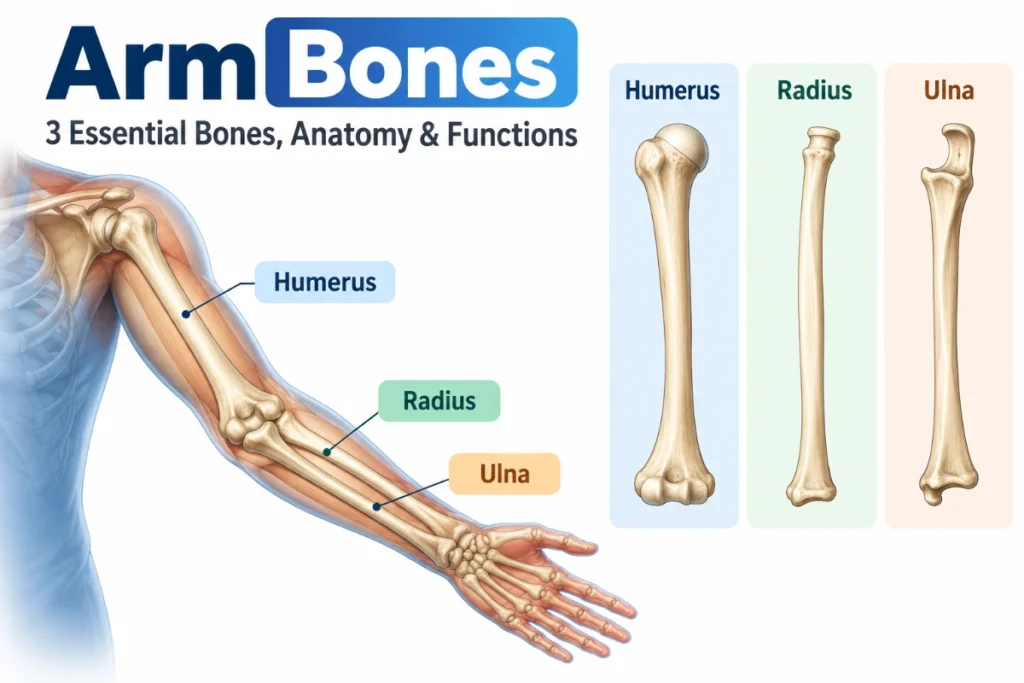
The three main arm bones are the humerus, radius, and ulna. The humerus runs from the shoulder to the elbow, forming the upper arm. The radius and ulna extend from the elbow to the wrist, forming the forearm. Together, these bones provide support, connect the major joints of the arm, and make movements such as bending, straightening, and turning the forearm possible.
In medical anatomy, the term arm refers specifically to the area between the shoulder and elbow, which contains only the humerus. The forearm is a separate region containing the radius and ulna. In everyday language, however, people generally use “arm bones” to refer to all three.
What Are the Three Arm Bones?
The humerus, radius, and ulna are long bones that support the upper limb and provide attachment points for muscles. Although each bone has a different role, they work together during everyday activities such as lifting objects, reaching overhead, turning a doorknob, and gripping tools.
| Bone | Location | Main function |
| Humerus | Upper arm, between shoulder and elbow | Supports shoulder and elbow movements |
| Radius | Thumb side of the forearm | Helps rotate the forearm and transfers forces through the wrist |
| Ulna | Little-finger side of the forearm | Stabilizes the elbow and supports forearm rotation |
In the standard anatomical position, the palms face forward, with the radius and ulna lying alongside each other. When you turn your palm downward, the radius crosses over the ulna.
Understanding the bones of the upper limb helps explain how their shapes and positions contribute to movement and stability.
Anatomy of the Arm Bones
Each arm bone has recognizable anatomical landmarks, including joint surfaces, projections, and attachment points for muscles and ligaments. These features help the bones fit together and move without losing stability.
Humerus: The Upper Arm Bone
The humerus is the only bone in the upper arm. Its upper end connects to the scapula (shoulder blade), while its lower end meets the radius and ulna at the elbow.
The main anatomical structures of the humerus include:
- Humeral head: The rounded upper end that fits into the glenoid cavity of the scapula, forming the shoulder joint.
- Anatomical and surgical necks: Two regions near the humeral head. The surgical neck is particularly vulnerable to fractures.
- Greater and lesser tubercles: Raised areas where muscles of the rotator cuff attach.
- Shaft: The long central section that provides support and attachment points for muscles.
- Capitulum and trochlea: Smooth joint surfaces at the lower end of the humerus. The capitulum connects with the radius, while the trochlea articulates with the ulna.
- Medial and lateral epicondyles: Bony projections near the elbow that serve as attachment sites for muscles and ligaments.
The humerus allows movement at both the shoulder and elbow. At the shoulder, it participates in raising, lowering, and rotating the arm. At the elbow, it works with the forearm bones to allow bending and straightening.
Radius: The Thumb-Side Forearm Bone
The radius lies on the thumb side of the forearm when the body is in anatomical position. It extends from the elbow to the wrist and plays a central role in forearm rotation and wrist function.
Its major anatomical features include:
- Radial head: A disc-shaped structure at the upper end that articulates with the humerus and rotates against the ulna.
- Radial neck: The narrower area immediately below the radial head.
- Radial tuberosity: A roughened projection where the biceps brachii tendon attaches.
- Shaft: The long middle portion connecting the upper and lower ends of the bone.
- Distal radius and styloid process: Structures near the wrist that help support joint stability and movement.
When you turn your palm upward or downward, the radius moves relative to the ulna. Its lower end also forms a major part of the wrist joint, connecting primarily with the scaphoid and lunate carpal bones.
Ulna: The Little-Finger-Side Forearm Bone
The ulna runs along the little-finger side of the forearm in anatomical position. It forms a stable connection with the humerus at the elbow and works alongside the radius during forearm rotation.
Its important anatomical landmarks include:
- Olecranon: The prominent bony point you can feel at the back of your elbow.
- Trochlear notch: A curved surface that fits around the trochlea of the humerus.
- Coronoid process: A projection that contributes to elbow stability.
- Shaft: The long central section that supports the forearm and provides attachment points for muscles.
- Ulnar head: The rounded lower end that articulates with the radius at the distal radioulnar joint.
- Ulnar styloid process: A small projection near the wrist that helps anchor supporting structures.
Unlike the radius, the ulna does not directly articulate with the carpal bones. An articular disc, part of the triangular fibrocartilage complex, separates it from the wrist bones.
How Do Arm Bones Work Together?
The humerus, radius, and ulna connect through joints that allow the upper limb to move in several directions. Muscles generate movement by pulling on the bones, while ligaments help keep the joints stable.
Shoulder, Elbow, and Wrist Connections
Shoulder joint: The rounded humeral head fits into the glenoid cavity of the scapula. This ball-and-socket joint allows the arm to move forward, backward, sideways, and through rotational movements.
Elbow joint: The lower end of the humerus connects with the radius and ulna. The humeroulnar articulation provides much of the elbow’s hinge-like stability, while the humeroradial articulation also contributes to movement. The anatomy of the elbow joint explains how these structures work together during bending and straightening.
Radioulnar joints: The proximal and distal radioulnar joints allow the radius to move relative to the ulna, enabling the forearm to rotate.
Wrist joint: The distal radius articulates with wrist bones and helps transfer forces between the hand and forearm. The ulna supports the wrist indirectly through nearby soft tissues.
Flexion, Extension, Pronation, and Supination
Four movements are especially important for understanding how the arm bones function:
- Flexion: Bending the elbow, which decreases the angle between the upper arm and forearm.
- Extension: Straightening the elbow, increasing the angle between the upper arm and forearm.
- Pronation: Rotating the forearm so the palm faces downward when the elbow is bent, or backward in anatomical position.
- Supination: Rotating the forearm so the palm faces upward when the elbow is bent, or forward in anatomical position.
Pronation and supination involve coordinated movement at the proximal and distal radioulnar joints, rather than simply bending the wrist. During these movements, the radius changes position relative to the ulna, allowing you to turn your palm upward or downward.
Common Arm Bone Fractures and Injuries
The humerus, radius, and ulna can break during falls, sports activities, vehicle accidents, or direct impacts. How much an injury affects movement depends on the bone involved, the fracture’s location, and its severity.
Humerus fractures can occur near the shoulder, along the shaft, or close to the elbow. They commonly cause pain, swelling, and difficulty moving the injured arm.
Radius fractures often affect the distal radius near the wrist, especially after a fall onto an outstretched hand. These distal radius fractures are among the most common upper-limb fractures. A fracture of the radial head near the elbow may also make forearm rotation painful.
Ulna fractures can result from a direct blow or a fall. They may affect the olecranon near the elbow, the shaft of the ulna, or occur alongside a radius fracture.
Common warning signs of an arm bone fracture include:
- Sudden or severe pain after an injury
- Swelling, tenderness, or bruising
- Visible deformity or an unusual arm position
- Difficulty bending, straightening, or rotating the arm
- Numbness, tingling, or weakness in the affected limb
Arm injuries can involve bones, joints, muscles, tendons, and other tissues, so symptoms alone cannot confirm a fracture. A suspected broken bone needs prompt medical evaluation, usually including X-rays. Seek emergency care if a bone has broken through the skin, the arm is severely deformed, the hand becomes cold or pale, or there is new loss of sensation or movement. Understanding common arm injuries and disorders can also help you recognize when an injury needs medical attention.
Read also: Knee Anatomy: Bones, Ligaments, Muscles, and Functions
Frequently Asked Questions
How many bones are in the human arm?
In anatomical terms, the upper arm contains just one bone: the humerus. If you’re referring to the upper arm and forearm together, there are three main bones-the humerus, radius, and ulna. The wrist and hand contain additional bones that belong to separate anatomical regions.
Which is the longest bone in the arm?
The humerus is the longest bone in the arm. It runs from the shoulder to the elbow and helps support movements such as lifting, reaching, and rotating the upper arm.
What is the difference between the radius and ulna?
The radius is on the thumb side of the forearm, while the ulna is on the little-finger side when the palms face forward. The radius is particularly important for forearm rotation and wrist articulation. The ulna provides much of the elbow’s bony stability and works with the radius during rotation.
Which arm bone is most commonly broken?
The distal radius, located near the wrist, is one of the most frequently fractured bones in the upper limb. A common cause is falling onto an outstretched hand. Fractures can also affect the humerus and ulna, depending on the type of injury.
Can you move your arm with a broken bone?
Yes, some people can still move their arm after a fracture, particularly if the broken bone has not shifted out of place. However, movement may be painful and could worsen the injury. If you suspect a fracture, support the arm, avoid unnecessary movement, and seek prompt medical evaluation.

0 Comments